
Dishwasher Not Cleaning Dishes? 11 Reasons and Fixes
You open the door expecting sparkling dishes and instead find gritty plates, a chalky film on the glasses, and bits of last night's dinner welded to the silverware. A dishwasher that runs a full cycle but leaves dishes dirty is one of the most common complaints in appliance repair, and the good news is that most causes trace back to a handful of simple parts you can inspect in a few minutes.
QUICK ANSWER: A dishwasher cleans by pumping hot water mixed with detergent up through spinning spray arms that blast the dishes from below and above. When cleaning fails, the problem is almost always in one of five areas: the water (temperature and flow), the spray (arms and holes), the heat, the detergent, or how you loaded the racks. A clogged filter is the single most common culprit.
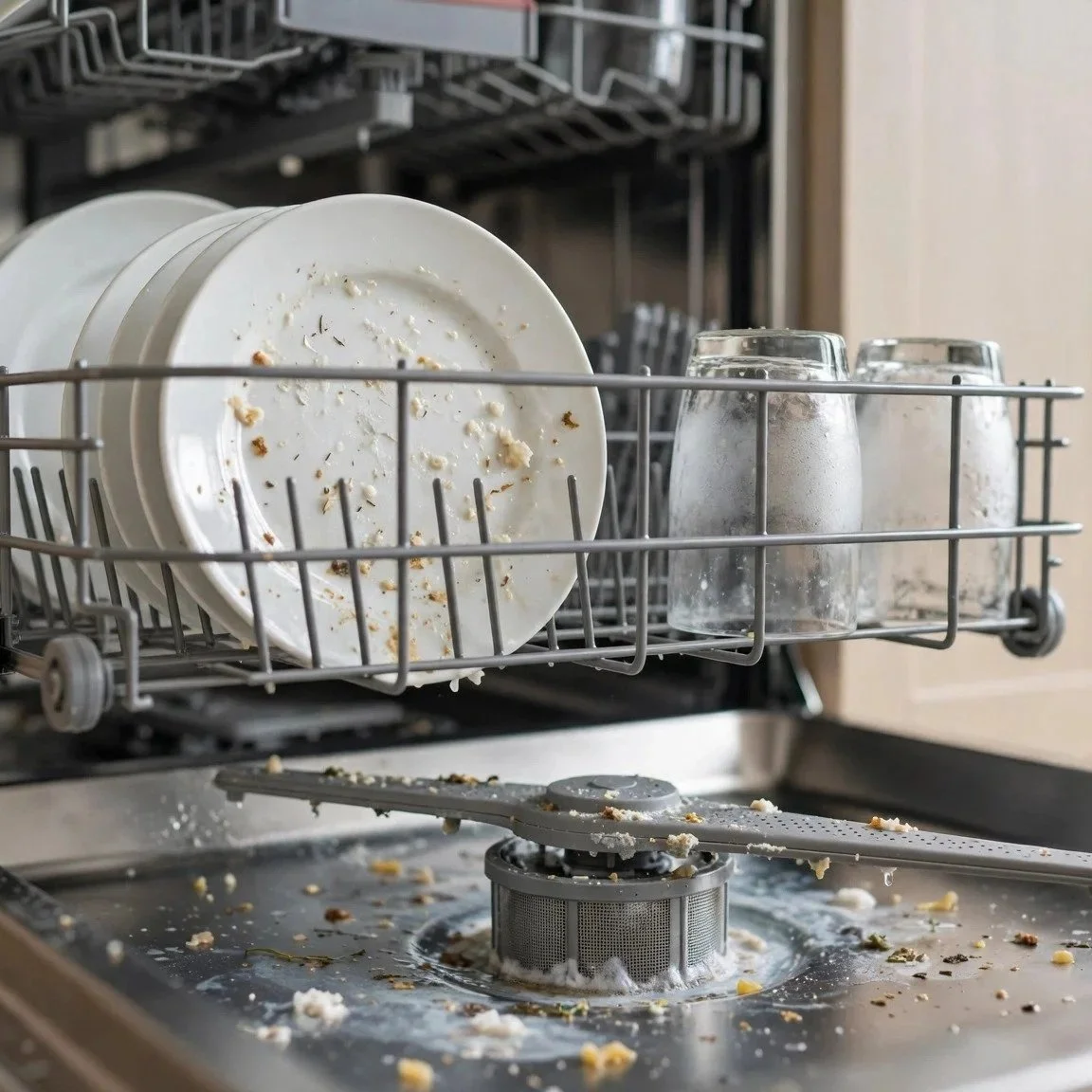
How a Dishwasher Actually Cleans
Understanding the wash cycle makes the causes obvious. A dishwasher does not soak your dishes in a tub of soapy water the way a sink does. It sprays them.
At the bottom of the tub sits a small reservoir called the sump. A wash pump pulls water from the sump and forces it up through hollow spray arms, usually one under the lower rack and one under or above the upper rack. Water shoots out of dozens of tiny angled holes, which makes the arms spin and throws pressurized jets across every surface in the machine. A heating element (or a heat exchanger on some models) keeps that water hot, detergent breaks down grease and starch, and a filter catches the food particles that rinse off so they are not sprayed back onto clean dishes.
That means good cleaning depends on five things working together: enough hot water, strong spray pressure, adequate heat, the right detergent, and dishes loaded so the spray can reach them. Break any link, and the dishes come out dirty. The list below walks through each failure point, roughly in order of how often it is the real cause.
The Common Reasons Dishes Come Out Dirty
A Clogged Filter (the Number One Cause): Most modern dishwashers have a removable filter assembly in the floor of the tub, usually a cylindrical mesh piece you twist out. Its job is to trap food so the pump can recirculate clean water. When that filter packs with grease, softened labels, seeds, and sludge, the machine ends up spraying dirty water back onto your dishes. The result is a gritty residue and a filmy haze on glasses. A filter that has never been cleaned is the reason a large share of "my dishwasher stopped working" calls turn out to be no repair at all.
Pull the filter, rinse it under a hot tap, and scrub the mesh with an old toothbrush and a little dish soap. Do this every few weeks if you rarely scrape plates.
Blocked Spray-Arm Holes: Those tiny jets in the spray arms clog with food debris and hard-water mineral scale over time. When enough holes plug up, water pressure drops and whole sections of the rack stop getting rinsed. You will often see one corner of the load come out clean while the rest stays dirty.
Slide each arm off (most pop off or unscrew by hand) and hold it up to the light. Poke every blocked hole clear with a toothpick or a short length of thin wire, then rinse the arm out.
Spray Arms That Cannot Spin: The arms have to rotate freely to reach the whole tub. A tall pot, a cutting board, or a utensil hanging through the rack can catch a spinning arm and stop it dead. If the lower arm cannot turn, only the dishes right above the sump get cleaned.
Before you start a cycle, give each arm a spin by hand and make sure nothing overhangs the rack far enough to block it.
Water That Is Not Hot Enough: Detergent enzymes and grease-cutting need water around 120 to 140 degrees Fahrenheit. If the incoming water is lukewarm, food and fat never fully release. A quick habit that helps: run the kitchen sink on hot for a few seconds before starting the dishwasher so the machine draws hot water from the first fill instead of cold pipe water.
If the water still runs cool, the dishwasher's own heating element or its thermostat may be failing. That is a diagnostic a technician should handle, since the element wiring carries live current.
Old, Wrong, or Skipped Detergent: Dishwasher detergent loses potency once the box or pouch has been open a while, especially in a humid kitchen where powder clumps. Using hand dish soap by mistake is worse, since it foams and can flood the floor. And skipping rinse aid leaves water clinging to surfaces, which is what dries into spots and film on glassware.
Buy detergent in amounts you will use within a couple of months, keep it sealed and dry, and keep the rinse-aid reservoir filled.
Hard-Water Scale and Film: In areas with hard water, dissolved calcium and magnesium leave a cloudy white film on glasses and a crusty scale inside the machine. That scale also narrows the spray-arm holes and coats the heating element, which slowly starves the wash of both pressure and heat.
Running a dishwasher-cleaner product, or a bowl of white vinegar on the top rack through a hot cycle, dissolves light scale and restores spray.
Overloading and Wrong Loading: Cramming in one more plate feels efficient until you realize dishes are nesting against each other and shadowing the spray. Bowls facing the wrong way fill with dirty water. Tall items in front block the jets reaching everything behind them.
Load so that every surface faces the center of the tub, keep pieces from touching, and never let one item block the path of a spray arm.
A Clogged or Kinked Drain: If the machine cannot fully drain, the next cycle starts by mixing fresh water into leftover dirty water. Dishes then get rinsed in a soup of old food. A drain hose that is kinked behind the cabinet, or a clogged air gap or garbage-disposal inlet, is a frequent hidden cause of standing water in the tub floor.
Check for water pooled in the sump before a wash and confirm the drain hose behind the unit is not pinched.
A Failing Wash Pump or Water-Inlet Valve: The wash pump creates the spray pressure and the inlet valve controls how much water enters. If the pump motor is weakening or the valve is partly clogged with sediment, the machine fills with too little water or sprays too weakly to clean, even though everything else looks fine. Symptoms include very quiet operation and dishes that come out almost as dirty as they went in.
These are internal parts behind the tub, and replacing them is a job for a technician.
A Cycle That Is Too Short or Not Hot Enough: The one-hour or "quick" setting is built for lightly soiled loads. On baked-on or greasy dishes, it simply does not run long enough or hot enough to do the work. Many machines also have an eco setting that lowers the water temperature to save energy, which trades cleaning power for efficiency.
For dirty loads, choose the normal or heavy cycle and turn on any "high temp" or "sanitize" option the machine offers.
What You Can Fix Yourself Versus When to Call a Tech
A quick reference for where the DIY line falls.
Do These Yourself First
Pull and scrub the filter under hot water.
Clear every spray-arm hole with a toothpick or thin wire.
Run the kitchen tap hot before starting a cycle.
Switch to fresh detergent and keep the rinse-aid filled.
Scrape, but do not heavily pre-rinse, so the detergent has soil to work on.
Reload so nothing blocks the arms and every surface faces the spray.
Run a dishwasher-cleaner or vinegar cycle to strip scale.
Pick the normal or heavy cycle with high-temp for tough loads.
A house sink cleans one item at a time under your control, while a dishwasher is a closed loop that recycles its own water. Keeping that loop clean, hot, and unobstructed is most of the battle, and the steps above solve the large majority of poor-cleaning complaints.
Call a Technician When
Water never gets hot, pointing to the heating element or thermostat.
The spray is weak even with clean arms and filter, pointing to the wash pump.
The tub fills with too little water, pointing to the water-inlet valve.
Cycles start and stop erratically, or the machine will not advance, pointing to the control board.
A few safety notes before you open anything up. Be careful with the door springs and the heating element, which are both injury hazards. Watch for sharp objects like broken glass or a fallen knife when you clear the filter. And if you notice a leak, an overheating unit, or a burnt smell, stop and call a technician rather than running the machine again.
WARNING: Cut power at the breaker before you reach near the heating element or wiring, since the element carries live current and stays very hot long after a cycle, so it can shock or burn you. Never mix bleach with another cleaner in the tub, because the combination can release toxic gas.
Frequently Asked Questions
No, and heavy pre-rinsing can actually hurt cleaning. Most enzyme-based detergents need food residue to grab onto, and a spotless plate gives the enzymes nothing to work on, which can leave a faint etched or filmy look. Scrape off bones, peels, and large chunks so they do not clog the filter, but leave the light soil for the machine.
For a household that scrapes plates well, once a month is a reasonable rhythm; if you rarely scrape or run the machine daily, every two weeks is safer. A fast test is to pull the filter and smell it. A sour or musty odor means biofilm has built up, and it is overdue, regardless of the calendar.
The upper rack is usually fed by the middle spray arm and a water supply tube that runs up the back or side of the tub. If that feed tube is cracked, disconnected, or clogged with scale, the top arm loses pressure while the bottom keeps cleaning normally. It is a different failure point than a dirty filter, which tends to leave grit everywhere.
Vinegar run through an empty hot cycle helps dissolve mineral scale, and a baking-soda rinse can freshen odors, but use them in separate cycles, not mixed together, since they neutralize each other into mostly water. Never combine vinegar or any acid with a bleach-based product, as that reaction gives off chlorine gas.
Yes, and it works two ways. Hard-water minerals deposit a visible film directly on glass, and over months they also coat the heating element and shrink the spray-arm holes, which quietly lowers both wash temperature and pressure. A rinse aid and periodic descaling counter the film; very hard water may call for a dishwasher-safe water softener or salt reservoir if the model has one.
Plastic does not hold heat the way ceramic and glass do, so it cools fast and water beads on it instead of sheeting off, which leaves droplets and any residue they carry. Loading plastics on the top rack away from the heating element, and keeping the rinse-aid reservoir filled, helps water roll off cleanly. Some plastics also stain from tomato-based food regardless of how well the machine runs.
Book an in-home diagnostic and get your dishes coming out clean again — nearly 20 years of honest, veteran-owned repair on gas and electric appliances. Freedom Appliance serves Tampa Bay and Riverview. Call (813) 302-7672.