
Washer Won't Spin or Drain? 7 Causes to Check First
QUICK ANSWER: A washer that won't drain usually won't spin either, because most machines are built to empty the tub before the drum accelerates. Common culprits include a clogged pump filter or drain hose, a small item jamming the pump, a failed lid switch or door lock, an unbalanced load, or a worn belt or motor coupler. Some of these you can clear yourself; the electrical and sealed parts need a technician.
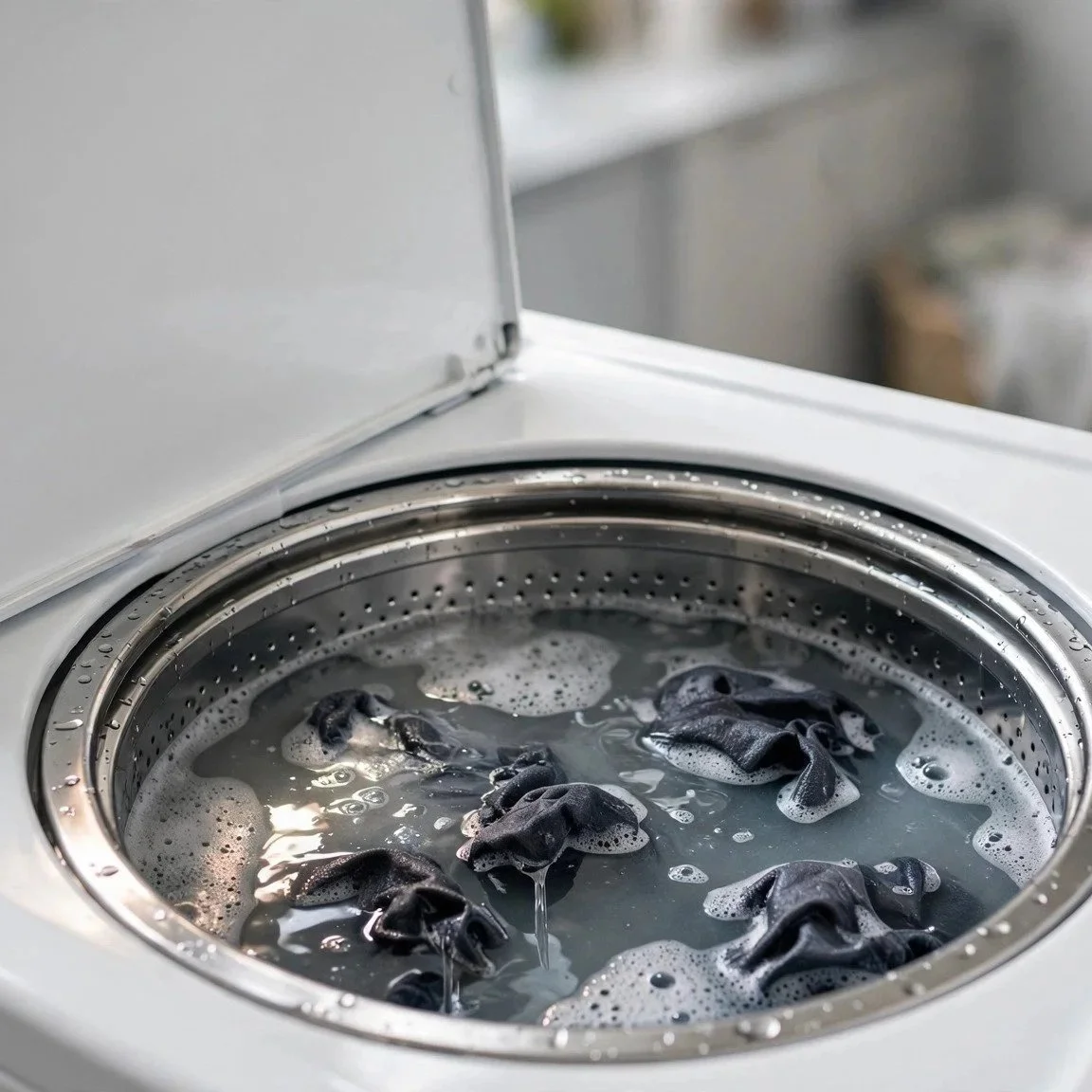
You open the lid expecting clean laundry and instead find a drum full of gray water and clothes that are still dripping. It is one of the most common washer failures, and it is also one of the most misread. People assume the spin motor died when the real problem is often that the machine never emptied the tub in the first place.
Why Draining Has to Happen Before Spinning
Your washer follows a fixed order of operations. After the wash and rinse, it pumps the dirty water out through the drain pump and hose, and only then does it ramp the drum up to spin speed. That sequence is deliberate. Spinning a tub full of water would throw the machine badly out of balance and send water flooding over the top of the tub, so the control logic holds the spin back until the drain is complete.
A car with the parking brake still set will strain and go nowhere no matter how hard you press the gas. The washer behaves the same way. If water is still sitting in the tub, the machine reads that as "not ready" and refuses to spin, even when the spin motor is perfectly healthy. This is why "won't drain" and "won't spin" are usually the same problem wearing two faces, and why chasing the spin motor first wastes time.
So the first question is not "why won't it spin," it is "did it drain?" If the tub is full of water, start with the drain path. If the tub is empty but the clothes are sopping, and the drum never turned, that points more toward the spin side: the belt, the coupler, or the lid or door switch that tells the machine it is safe to spin.
TIP: Before chasing the spin motor, answer one question first: did it drain? If the tub is still full of water, start with the drain path, because most washers hold the spin until the tub empties, so a drain fault looks exactly like a dead spin motor.
Homeowner-Checkable Causes
Several of the usual causes are things you can inspect without opening the cabinet. Before you touch any of them, unplug the washer and shut off the hot and cold water valves. If the drum is full, the pump and hoses are holding standing water that will pour out the moment you disconnect them, so bail the drum down with a cup and a bucket first, then lay towels around the base.
Redistribute an unbalanced or overloaded load: A wad of heavy items bunched on one side, a single soaked comforter, or a drum packed past its limit can trip the balance sensor. The machine detects the wobble, aborts the spin to protect itself, and often leaves the load wet. Open the door, spread the items evenly around the drum, remove a few pieces if it is crammed, and run a spin-only or drain-and-spin cycle. This alone resolves a surprising share of "won't spin" calls.
Unkink and clear the drain hose: The drain hose runs from the back of the washer to a standpipe or laundry tub. If it is pinched behind the machine, looped too high, or pushed too far down the standpipe, water cannot leave. Pull the washer out gently, straighten any kink, and confirm the hose is not jammed hard against the wall. While it is disconnected, check for a clog of lint and hair, which builds up right at the bend.
Clean the pump filter on a front-loader: Most front-load washers, and some newer high-efficiency top-loaders, have a small access door at the lower front of the cabinet. Behind it is the drain pump filter, the trap that catches coins, buttons, hairpins, and the occasional missing sock before they reach the pump. Have a shallow pan and towels ready, twist the filter cap out slowly, and let it drain. A filter packed with lint and debris is one of the single most common reasons a front-loader stops draining, and manufacturers suggest cleaning it every month or two.
Confirm the lid or door latch is fully engaged: A top-load washer will not spin unless the lid is closed and the lid switch registers it. A front-loader will not run unless the door lock clicks shut. Push the lid or door until it latches firmly and listen for the click. If the latch is cracked or the strike is worn, the machine thinks the door is open and holds everything, including the drain and spin.
Deeper Causes That Point to a Technician
If the load is balanced, the hoses are clear, the filter is clean, and the latch is closed, the problem has moved inside the machine.
Drain pump: The pump itself can fail, either from a burned-out motor or from a small hard object, a coin or a shard of plastic, lodged in the impeller. A jammed impeller sometimes makes a grinding or humming sound while the water never moves. Clearing a pump means removing it and is a job for a technician, since it involves the sealed water side of the machine.
Lid switch or door lock assembly: These are safety devices, and when they fail electrically, the machine assumes the door is open and disables the spin. Replacing them requires opening the cabinet or the door boot and working with the wiring.
WARNING: Never bypass or defeat a lid switch or door lock to force a spin. It removes the protection that keeps hands and clothing out of a moving drum.
Drive belt: Many washers turn the drum with a rubber belt. When it stretches, glazes, or snaps, the drum stops turning while the motor keeps running, so you hear the machine work but nothing spins. A worn belt often leaves a faint rubber smell.
Motor coupler: On many direct-drive top-loaders, a plastic-and-rubber coupler links the motor to the transmission. It is designed to wear out and break rather than let the motor damage the transmission, so a failed coupler is a common cause of a drum that agitates weakly or not at all and will not spin.
Control board: The board runs the wash sequence, and a fault there can scramble the drain and spin commands even when every mechanical part is fine. Power quality matters too; lightning and voltage surges are hard on appliance electronics, and a surge-damaged board is a technician-level diagnosis and repair, which is why a dedicated outlet and a surge protector rated for large appliances are worth having.
Top-Load Versus Front-Load Differences
The two designs fail a little differently, and knowing which you have narrows the search.
On a top-loader, the lid switch and, on direct-drive models, the motor coupler are frequent offenders, and older belt-driven machines add the drive belt to the list. Top-loaders are also more sensitive to an unbalanced load, since the tub spins on a vertical axis and a lopsided load throws it off quickly.
On a front-loader, the accessible pump filter is the first thing to check, and the door lock is the common electrical fault. Because the drum spins on a horizontal axis at high speed, a front-loader is especially strict about draining fully before it will spin, and it will simply refuse the spin rather than risk the imbalance.
When to Call a Technician
Reach for a pro when the drum still will not spin after you have balanced the load, cleared the hose, cleaned the filter, and confirmed the latch. Call sooner if you hear grinding or humming with no water movement, smell burning rubber, see the machine trip a breaker, or find water leaking from underneath. Anything involving the motor, the control board, the sealed pump, or the lid and door safety switches belongs with someone who can test the parts and replace them correctly, rather than guessing at it with the cabinet open and the power on.
Frequently Asked Questions
Yes, and it is worth doing before any inspection. Set the drain hose down into a bucket below the level of the drum and gravity will siphon much of the water out; for the rest, bail with a cup. On a front-loader, the small drain tube tucked beside the pump filter is made for exactly this, so pull it out over a pan before you open the filter cap.
Pricing is best confirmed with the technician who inspects your specific model, since the pump part and the labor to reach it vary widely between brands and between top-load and front-load designs. Get the diagnosis first so any estimate reflects the actual fault rather than a guess.
That combination usually points to the drain path as the culprit and the spin side as the issue. On a top-loader, suspect a failed lid switch, a broken motor coupler, or a stretched drive belt; on a front-loader, suspect the door lock or the belt. A load that is still badly unbalanced after draining can also block the final high-speed spin on its own.
It can be, especially in a humid climate where a wet drum and gasket dry slowly. Front-load door gaskets trap moisture in their folds and grow mildew if left damp, so after you fix the drain, wipe the gasket dry, leave the door ajar between loads, and run an occasional cleaning cycle.
Overusing detergent, or using regular detergent in a high-efficiency machine, creates excess suds that a pump cannot push through, and the machine may pause or fault mid-cycle. If you have had repeated no-drain trips, switch to an HE-rated detergent and cut the dose to the line marked on the cap, then run a rinse to clear the residue.
A standard spin runs roughly six to twelve minutes depending on the model and the selected speed, and the machine may pause several times early on while it senses balance and redistributes the load. If it pauses, refills, and retries far longer than that without reaching full speed, it is fighting an imbalance or a drain that is not completing, which is your signal to check the load and the drain path.
Book a washer diagnosis today — get an honest fix from techs with nearly 20 years on gas and electric appliances. Freedom Appliance of Tampa Bay serves Tampa Bay and Riverview. Call (813) 302-7672.