Dryer Runs but No Heat? 5 Fixable Reasons
A dryer that spins happily but leaves your clothes cold and damp is telling you something specific. The motor and the heat source are two separate systems, and the motor can keep running long after the heat has quit. That split is why you can open the door to a full tumble and a chilly, still-wet load. Once you know which of the two systems has failed, the fix usually points itself out.
Below are the real causes, ordered roughly by how common they are, followed by the checks you can safely do yourself and the ones that belong to a technician.
QUICK ANSWER: A dryer that runs without heat usually points to one of five things: a clogged lint filter or vent choking airflow and tripping a safety, a blown thermal fuse, a failed heating element (electric) or bad igniter or gas valve coil (gas), one tripped leg of a 240-volt breaker so the motor spins but the element gets no power, or a bad thermostat. Start by cleaning the lint screen and vent, confirm the cycle is not set to air-fluff, and check both breakers.
The Airflow Problem Behind Most No-Heat Dryers
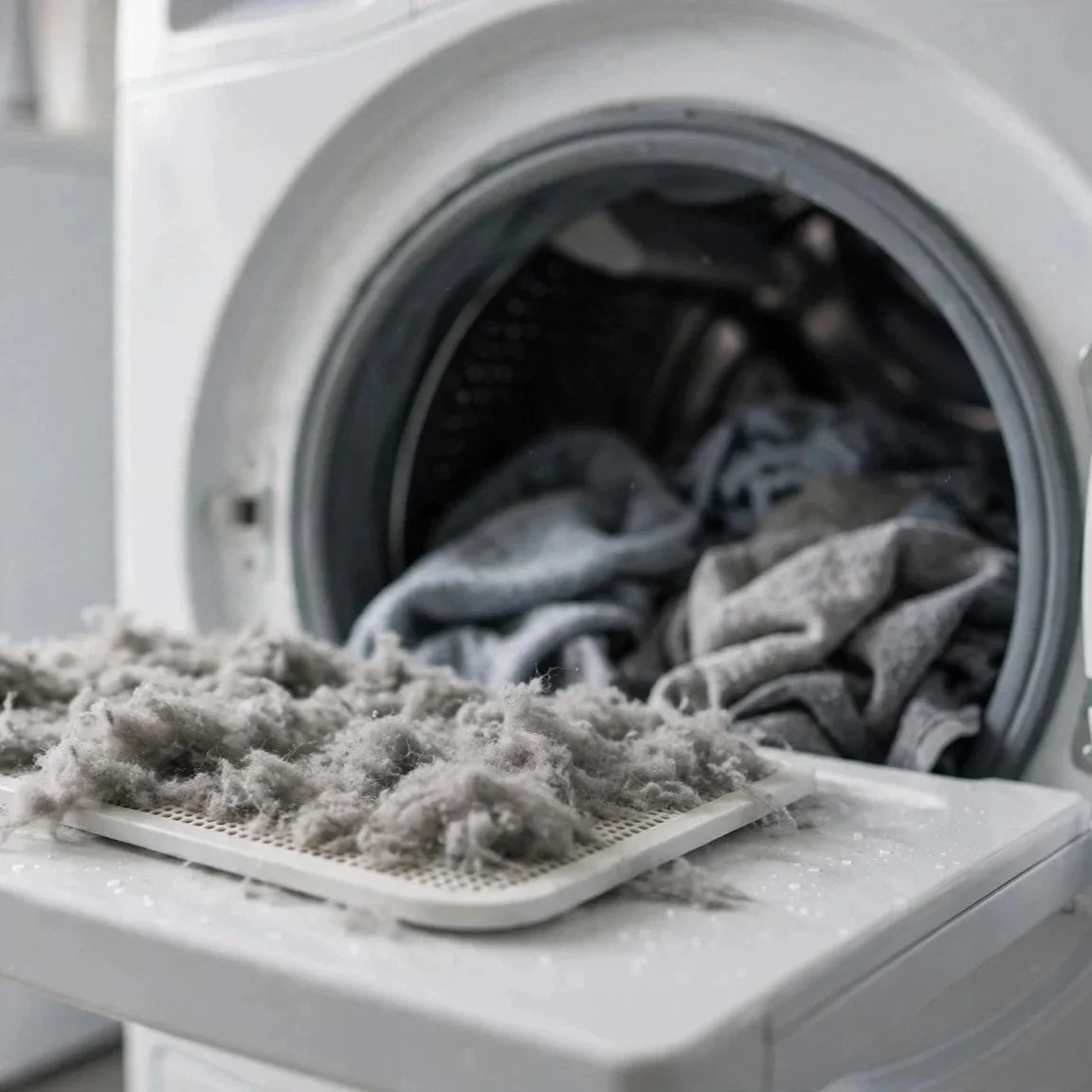
Before you suspect a broken part, look at airflow. A dryer needs a steady stream of air moving through the drum and out the vent. That moving air carries away moisture and, just as importantly, keeps the heating components from overheating. When lint packs the filter or clogs the duct, hot air has nowhere to go. Temperatures inside the cabinet climb, and a built-in safety shuts the heat off to protect the machine. The motor keeps turning, so the drum still spins, but the heat is gone.
This is the single most common reason a dryer runs cold, and it is also the reason lint deserves real respect. Packed lint is dry, fluffy, and highly flammable, and a restricted vent traps heat right next to it. Clogged dryer vents are a leading cause of home fires every year. Cleaning the lint filter and clearing the duct is not just about getting your heat back; it is about removing a fire hazard from your laundry room.
How to tell airflow is the culprit: Feel the exterior vent hood while the dryer runs. Strong, warm airflow means the duct is mostly clear. Weak or barely-there airflow points to a blockage. Clothes that take two or three cycles to dry, a cabinet that feels hot to the touch, or a burning, dusty smell all point the same direction. Humid conditions make this worse, because damp lint clings and builds faster than dry lint, and that holds true in muggy weather just as much as in cool, dry weather.
The Thermal Fuse: A Safety That Usually Blames the Vent
Every modern dryer has a thermal fuse, a small one-time safety device mounted on the heat housing or near the blower. When temperatures rise past a safe limit, the fuse blows and cuts power to the heating circuit. On many machines, the motor is on a different circuit, so a blown thermal fuse leaves you with a dryer that tumbles but never warms.
Here is the part that trips people up. A blown thermal fuse is almost always a symptom, not the root cause. It blew because something made the dryer overheat, and nine times out of ten that something is a blocked vent. Replace the fuse without clearing the vent and the new fuse will blow again, sometimes within a load or two. The vent has to be cleared first.
One firm rule: never bypass or jumper a thermal fuse to force the heat back on. That defeats the exact protection standing between an overheating dryer and a fire. A fuse is cheap; a house fire is not.
WARNING: Never bypass or jumper a thermal fuse to force the heat back on. That defeats the exact protection standing between an overheating dryer and a fire, and lint-packed vents are already a leading cause of home fires every year.
When One Leg of the Breaker Trips
Electric dryers run on 240 volts, which is really two 120-volt "legs" delivered through a double breaker. The motor, drum light, and control panel typically run on just one 120-volt leg. The heating element needs both legs together to reach 240 volts.
That wiring quirk creates a classic symptom. If one leg trips or fails while the other holds, the dryer powers up, the drum spins, the light comes on, and everything looks normal, except there is no heat. The element has no power. People often glance at the breaker panel, see the dryer breaker looking "on," and move past it, but a double breaker can have one half tripped while the other stays seated.
TIP: If the drum spins and the light works but there is no heat, flip the dryer's double breaker fully off, then fully back on. A partly tripped breaker can rest in a middle position that looks on but is not carrying current on the leg the heating element needs.
Electric Element Versus Gas Igniter
What actually makes the heat depends on whether your dryer is electric or gas, and the failure points differ.
Electric dryers: An electric dryer heats with a metal coil called the heating element, housed in a chamber the incoming air passes over. Over time, the coil can burn out or crack, breaking the circuit. When that happens, the element produces no heat at all while the rest of the machine runs fine. A failed element is one of the most common no-heat causes on electric models, and it is a 240-volt component that a technician should test and replace.
Gas dryers: A gas dryer lights a small burner. An igniter glows hot, and once it reaches temperature, a gas valve coil opens to release gas, which the igniter lights. If the igniter weakens and no longer gets hot enough, or if a valve coil fails and gas never releases, the burner never lights. You get a running drum and cold air. Gas dryers also have a flame sensor that must confirm the flame, and a fault there can stop ignition too. Anything involving the gas valve, igniter, or gas line is a technician job, full stop.
The Thermostat and Other Controls
Dryers use one or more thermostats to regulate temperature, cycling the heat on and off to hold the drum in the right range. A cycling thermostat that fails open will keep the heat switched off, and the result looks identical to the other no-heat faults: a normal-sounding dryer with a cold drum. A high-limit thermostat can fail the same way, and like the thermal fuse, a tripped high-limit often traces back to poor airflow. Testing these calls for a meter and knowledge of which reading is normal for your model, which is where a technician earns the visit.
Checks You Can Safely Do Yourself
Work through these before calling anyone. Most no-heat calls that turn out simple are solved right here.
Safety first: Unplug an electric dryer before you touch anything internal. For a gas dryer, shut off the gas supply valve and switch off the breaker. Do not skip this step.
Clean the lint screen: Pull it out and clear every load's worth of lint. If a film has built up from dryer sheets, wash the screen in warm soapy water and let it dry fully.
Clear the vent: Disconnect the duct from the back of the dryer and check both the duct and the exterior vent hood for packed lint. Clear it out. This is the fix that solves the most cases and removes the fire risk at the same time.
Confirm the cycle setting: It sounds almost too simple, but an air-fluff or no-heat cycle tumbles without heat by design. A bumped dial or a child pressing buttons is a real and common cause. Switch to a timed or automatic heat cycle and test again.
Cycle both breakers: Flip the dryer's double breaker fully off and back on to reseat a half-tripped leg.
Feel the outside vent: With a heat cycle running, check for strong warm airflow at the exterior hood. Weak airflow sends you back to the vent-clearing step.
When to Call a Technician
If the lint screen is clean, the vent is clear, the cycle is right, and both breakers are seated, the fault is almost certainly inside the machine: a blown thermal fuse, a failed heating element, a bad igniter or gas valve coil, or a faulty thermostat. Those repairs mean opening the cabinet and working around 240-volt wiring or a gas line, and diagnosing them correctly takes a meter and model-specific readings.
A repeat-tripping breaker, a blown fuse that blows again after the vent is cleared, or any smell of gas is a firm stop-and-call signal. So is a dryer that overheats. Getting the diagnosis right the first time is safer and cheaper than swapping parts by guess.
Frequently Asked Questions
Yes, and it is common. Many dryers put the motor and the heating circuit on separate paths, so a high-limit thermostat or thermal fuse can cut the heat while the motor circuit stays live. You will often notice the cabinet is unusually hot to the touch and the load smells faintly scorched, both signs the machine is running hotter than it should and that airflow needs attention.
For most households, once a year is the baseline, but a home that does frequent large loads or uses a long or twisting duct run should clean it more often. Vent runs longer than the manufacturer's stated maximum, or ones with several elbows, trap lint faster and may need attention every six months. A mesh lint trap on the exterior hood should be checked seasonally because it clogs from the outside in.
On most models, yes. The thermal fuse sits in the heating circuit, not the motor circuit, so a blown fuse leaves the drum spinning and the timer advancing while the heat stays off. That is exactly why a no-heat dryer fools people into thinking the whole machine is fine. A few designs wire the fuse so the dryer will not start at all, which is why the symptom varies by brand.
Both fail, but they fail differently. Electric models most often lose heat to a burned-out heating element or a tripped 240-volt leg. Gas models more often stall at ignition, from a weak igniter, a failed gas valve coil, or a flame sensor that will not confirm the flame. Gas units have more moving pieces in the heat sequence, so the ignition-stage faults are a category electric dryers simply do not have.
Yes, and it is a distinct issue from no heat at all. Auto-dry cycles read moisture through two metal strips inside the drum. Fabric softener residue can coat those strips and fool the sensor into reading the load as dry, ending the cycle early with heat that never got the job done. Wiping the sensor bars with a little rubbing alcohol clears the film and often restores normal cycle length.
It can. In very humid conditions, a load holds more water going in, and the air pulled through the drum is already damp, so the dryer works longer and the clothes feel cool and wet well into the cycle. The heat may be working fine but losing the race against moisture and a marginal vent. Clearing the vent so moist air exits quickly makes the biggest difference, and it matters year-round, not only in the wettest months.
Book a dryer diagnostic today — get the heat back safely and cut the lint-fire risk. Freedom Appliance of Tampa Bay serves Tampa Bay and Riverview. Call (813) 302-7672.