
Dryer Taking Two Cycles to Dry? What's Really Wrong
You start the dryer, wait for the buzzer, and pull out a load that is still damp at the seams. So you run it again. That second cycle used to be the exception; now it is just what drying a load takes, and you cannot remember exactly when that changed. It was not a switch flipped overnight; it crept in one load at a time until "run it twice" became the routine.
That creeping timeline is the most useful clue you have. A dryer that fails all at once, tumbling cold on the first try, is telling a different story than one that got a little slower every month for half a year. The second pattern almost always traces back to something blocking the path air takes through the machine, rather than to the part that generates heat.
A Dryer Moves Air More Than It Makes Heat
It helps to drop the idea that a dryer "bakes" moisture out of clothes. It actually pulls in air, warms it, pushes it through the tumbling load so the warm air can absorb water vapor off the fabric, and exhausts that now-humid air outside the house. The heating element makes the air thirsty for moisture; the fan and duct keep that air moving, pushing the wet air out before it recirculates.
When something narrows the path that air travels, the machine can still produce full heat and still tumble on schedule, but the moisture has nowhere to go. It just recirculates, already saturated, unable to pick up anything more from the clothes. The auto-dry sensor keeps reading damp fabric and restarts the cycle, or the timer runs out with the clothes still wet. Either way, you are looking at a machine that runs fine and still cannot finish the job in one pass.
Why A Slow Slide Points To Airflow, Not The Heating Element
This is the part worth sitting with, because it changes where you look first. A heating element or a cycling thermostat tends to fail in a fairly sudden, complete way: one day the drum spins and the clothes come out cold, full stop. Airflow restriction behaves nothing like that. Lint does not clog a vent in one afternoon; it builds a little at a time, load after load, until the passage that used to move air freely is down to a fraction of its width.
That gradual mechanism is exactly why a slowly worsening pattern, one cycle stretching into ninety minutes, then two hours, then a second full cycle over a matter of weeks or months, points toward a shrinking airflow path rather than a part that quit. A failing element causes an abrupt no-heat symptom that you would notice within a single load. A narrowing vent gives you the "it's just taking longer lately" complaint that sneaks up on a household. If you can trace the slowdown back several months and watch it worsen in steps, start with the air path before you suspect the parts that generate heat.
The Lint Trap Rarely Tells The Whole Story
The screen inside the door is the obvious suspect and deserves attention, but a lint trap that looks clean to the eye can still be quietly restricting airflow. Dryer sheets and liquid fabric softener leave a waxy residue on the mesh that builds up invisibly, coating the weave until water beads on the surface rather than passing straight through.
Pull the screen and run tap water across it. If the water pours through in a steady sheet, the mesh is clear. If it pools or drains slowly, the screen is glazed and cutting airflow even though it looks lint-free. A soft brush, warm water, and dish soap cut through the film; let the screen dry fully before it goes back in. Clearing a glazed screen alone sometimes shaves real time off a cycle, though a clean screen with a still-clogged duct behind it will not fix a two-cycle habit on its own.
Following The Air Path Into The Vent And Duct
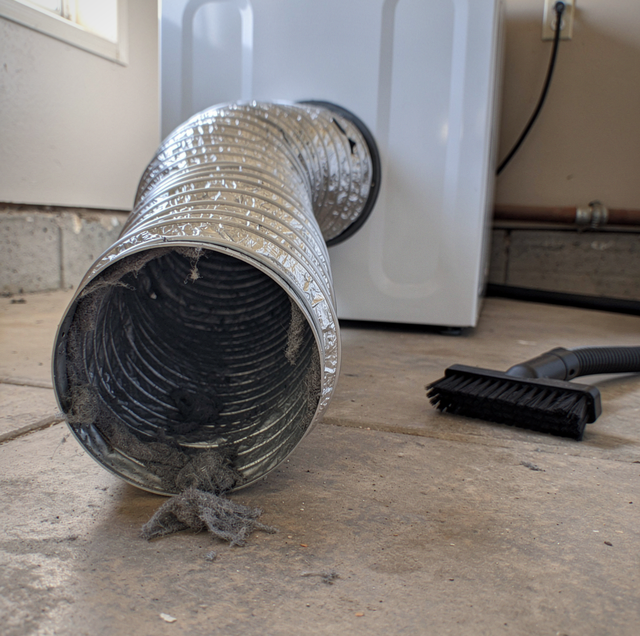
Past the screen, the exhaust duct carries the moist air from the back of the dryer, through the wall or ceiling cavity, and out to a hood on the exterior of the house. Lint that slips past the screen in tiny amounts settles inside that duct, and over a year or two it can felt into a layer that shrinks the passage well below its rated diameter.
Two things make this worse than the screen alone. Shape matters: ribbed foil or plastic transition hose traps lint in every fold and crushes it flat once the dryer is pushed back against the wall, while smooth, rigid, or semi-rigid metal duct gives lint nothing to grab. Length and turns add up, too, since every elbow adds resistance roughly equal to several extra feet of straight pipe, so a duct with three tight bends can behave as if it were twice as long as it looks.
A quick outdoor check tells you a lot: with the dryer running, hold your hand near the exterior vent hood and feel for a strong, warm push of air. A weak trickle, or a flap that barely lifts, means the run is restricted somewhere between the dryer and the outside world. Clearing it means disconnecting the duct at both ends, vacuuming what you can reach, and running a flexible vent brush through the stretch in between. A duct left untouched for years is also a fire consideration, since packed lint against warm exhaust is a common cause of laundry-room fires.What Is Safe to Check Yourself
When The Load Itself Fights The Dryer
Sometimes the restriction is not in the machine at all. Airflow needs open space to move through the clothes as they tumble, and a packed drum leaves almost none. The outer layer of a crammed load dries while a dense wad in the center stays wet, so the sensor keeps extending the cycle chasing moisture it cannot reach evenly.
Loads mixed by weight cause a similar problem. Towels, jeans, and bath mats hold far more water than shirts and sheets do. Dried together, the lighter pieces finish first while the heavier items stay soaked, and the whole load runs long chasing the slowest piece. Two right-sized loads that tumble loosely often finish faster in total than one oversized load run through twice.
What A Truly Failing Heating Element Looks Like
If the screen is clean, the vent tests strong at the hood, and the loads are reasonably sized, but drying still drags, the cause has likely moved inside the cabinet. A heating element that is starting to fail rarely does so gently: it typically either works or it does not, producing full heat one day and a cool, slow tumble the next. That abrupt, complete shift is the signature to watch for, and it is a different symptom than the gradual creep an airflow problem produces.
A cycling thermostat, which switches heat on and off to keep the drum within range, or a high-limit thermostat, which shuts off heat if the cabinet runs too hot, can also fail and mimic a weak element. Because a high-limit thermostat is often tripped by the very airflow restriction you just ruled out, a technician usually checks the vent history before condemning the part. Electrical component testing, along with anything involving a gas burner or igniter, is the responsibility of a licensed technician; these parts are wired to line voltage or connected to a gas supply, and testing them safely requires a meter and model-specific readings.
The Moisture Sensor's Quiet Role
Most dryers built in the last couple of decades use an auto-dry setting that senses moisture through two metal strips mounted just inside the drum, ending the cycle once the load reads dry rather than running a fixed timer. Fabric-softener residue coats those sensor bars the same way it coats the lint screen, and a filmed-over sensor can misread a load as still wet long after it has actually finished, extending the cycle for no real reason.
Wiping the sensor bars with a cotton pad and a little rubbing alcohol removes that film and, on some units, shortens a stretched-out cycle on its own. A sensor that keeps misreading after cleaning, or lets loads come out bone dry and overheated instead, has likely failed rather than gotten dirty, and calls for a technician's diagnosis instead of repeated cleanings.
Working Through It In Order
Because the gradual pattern points so reliably to airflow, work the obvious causes first: wash a glazed lint screen, confirm strong airflow at the exterior vent hood, swap a crushed transition hose for smooth, rigid duct, and split an oversized or mixed-weight load into two reasonable loads. Most two-cycle complaints resolve at one of those four steps, usually the vent.
If airflow checks out clean and the problem still has not budged, or the shift from one cycle to two happened suddenly rather than over months, the fault has likely moved to a part behind the drum: the heating element, a thermostat, or a sensor that needs more than a wipe-down. A technician who can pull the panel and test with a meter will find the answer faster and more safely than continuing to guess.
Frequently Asked Questions
Yes, and it is easy to overlook. Standard dryer duct runs four inches in diameter; a duct reduced to three inches to fit a tight wall cavity or an odd transition moves noticeably less air even when perfectly clean, so a narrow-diameter run can produce the same two-cycle symptom as a wide duct that is half-clogged with lint.
It can, if the new location changes the duct run's length or adds bends. Manufacturers cap the total equivalent length of a vent run, and every elbow counts as several feet of straight pipe against that limit, so relocating a dryer farther from an exterior wall, or routing the duct around a doorway or floor joist, can push a previously fine setup past the point where airflow holds up.
A booster fan, mounted mid-duct and triggered by airflow or a pressure switch, can help on runs that are long or turn-heavy but otherwise clean and correctly sized, since it adds mechanical push to a passage that is simply too long for the dryer's own blower alone. It is not a substitute for clearing an actual lint blockage; installing one on a duct that is still dirty just moves stagnant, humid air a little faster rather than solving the restriction.
Yes. The same waxy film that glazes a lint screen and coats sensor bars can also settle inside the drum and the lint-screen housing, and buildup there can trap extra lint that would otherwise pass through the screen and be caught normally. Wiping the drum interior with a damp cloth every so often, along with the screen and sensor bars, keeps that buildup from becoming another small contributor to a long cycle.
Timing a dry load with a small, known-dry test item, such as a single bath towel fresh from the wash, on the same cycle settings every few months gives you a rough baseline. A steadily creeping time on that same test load with airflow confirmed strong points toward the element weakening rather than a sudden mechanical failure, since electric heating coils can occasionally degrade in output before they finally give out completely.
Yes, and it is not a malfunction. Heat-pump and ventless condenser dryers operate at meaningfully lower drum temperatures than a standard vented dryer, recycling and dehumidifying air inside a closed loop rather than exhausting it outside, and that gentler process is inherently slower per load. A ventless unit taking closer to two hours for a single cycle is within normal design behavior; a sudden jump beyond its usual runtime, on top of that baseline, is the signal worth investigating on these models.
Schedule a dryer vent inspection and repair — get accurate airflow testing and a fix for whatever is actually lengthening your drying time. Freedom Appliance of Tampa Bay serves Tampa Bay and Riverview. Call (813) 302-7672.