
Dishes Still Wet After the Dishwasher? The Heat Ran Out
Look along your dishwasher's control panel for a heated dry button. If there is none, the machine has no drying element at all, and nothing on the racks warms after the final rinse. Everything the load dries with, it absorbed while that rinse was still running.
No heat is added afterward. So when the glasses come out dry, and the storage lids come out steaming, nothing has failed. The heat ran out where the physics says it should, and the question worth asking is which drying path your machine uses and what starved it.
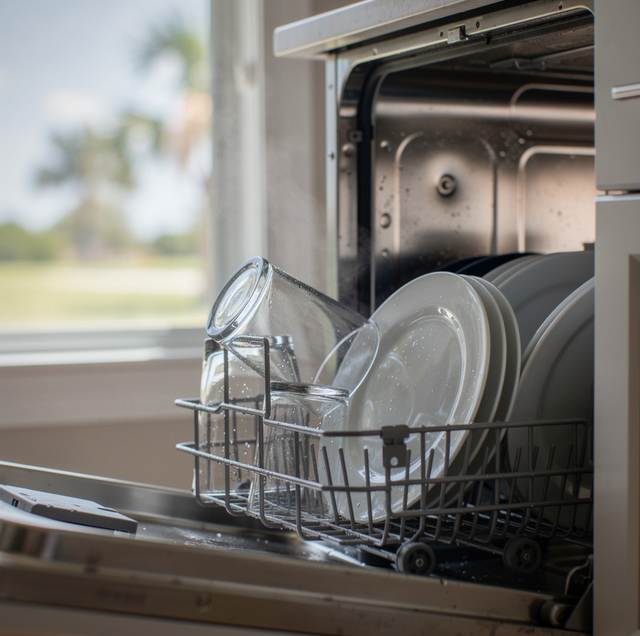
The Dry Cycle That Has No Heat Source
Water leaving that rinse puts its heat into the water that drains away, the tub, and everything on the racks. Your dishes keep theirs. Over the next half hour, that stored heat evaporates the film on every surface, and the tub fills with vapor.
That vapor has to go somewhere, and on a condensation machine it goes to the wall. A stainless tub is thin, conductive, and in contact with room air on its outer face, so it sits below the temperature of a plate fresh out of the final rinse. Vapor reaching that colder steel condenses, runs down, and leaves with the last drain. Nothing blows it out.
Two conditions have to hold, and both fail quietly: your dishes have to be hot enough to drive their own water off, and the wall has to stay colder than they are. Federal energy rules cap how much energy a residential dishwasher may use per cycle. A dedicated drying element is a resistance heater running for many minutes after the wash ends, and that block of energy has to fit under the cap. Condensation drying costs nothing extra because it reuses the heat the cycle already produced: the rinse water is heated regardless, and the load's own stored heat is free during drying. How hot that rinse gets varies by machine and by cycle. Without a drying element, there is no second attempt if either condition slips.
Why the Glass Comes Out Dry, and the Lid Comes Out Wet
Run the arithmetic and the complaint dissolves. Soda-lime glass holds about 0.84 joules per gram per kelvin, and polypropylene, the resin in food-storage lids, holds roughly 1.9. That sounds like the plastic wins until you weigh the two: a glass tumbler is around 250 grams, a lid around 15.
Heat available for drying is mass times specific heat times the temperature the item falls through. The tumbler carries about 210 joules for every degree Celsius it cools; the lid carries about 29. Evaporating a single gram of water takes roughly 2,260 joules, so a tumbler dropping twenty degrees holds close to two grams' worth of water's energy, and the lid about a quarter of a gram's worth.
A thin plastic item has enormous surface area for its mass, so it dumps its heat into the tub air within a minute of the rinse ending and then sits at tub temperature with its droplets intact. Your glass is still pushing heat into its own water film ten minutes later.
What Rinse Aid Does to the Water Film
Water at room temperature holds a surface tension of about 72 millinewtons per meter. That is why a droplet is a droplet: the liquid pulls itself into the smallest surface its volume allows.
A bead is close to the worst shape for drying. It touches your plate over a tiny footprint, so the heat that has to evaporate it arrives through a narrow path, and there is real depth behind that footprint at 2,260 joules a gram. Gravity cannot help either, because the contact line is pinned where it sits.
Read the panel on a rinse-aid bottle, and you will find nonionic surfactants. Those molecules crowd the boundary between water and air and cut the tension there, so the same water spreads into a sheet. A sheet touches the dish across its entire area, transfers heat quickly, and runs off as a liquid before evaporation is required.
Skipping rinse aid costs you more in drying than in washing. A heated dry cycle can force a bead off with added air heat; a machine drying on stored heat has no surplus, so every bead is one your dishes must boil off themselves.
The Failures That Belong to the Machine
Everything above assumes your load reached rinse temperature. What stops it runs from the water main to the end of the cycle.
The supply comes first. A dishwasher takes a short, fast fill, so it gets whatever stands in your branch line. A long run from the water heater holds cooled water, and a machine without its own booster heater works from what it is handed.
TIP: Run the kitchen tap nearest the dishwasher for 30 seconds, then read the temperature with an instant-read thermometer. Compare that figure against the minimum inlet temperature printed in your own machine's installation manual before you suspect the element.
Next is the machine's own heating. On models that heat, the element under your lower rack raises rinse water and, on heated dry, warms tub air afterward. An element that has failed open puts nothing into the water either, so washing falls off alongside drying. Spotless dishes that are merely wet point away from the element.
Then the vapor's exit. Machines that vent carry a flap in the inner door driven by a wax motor, with a fan behind it. A flap that will not open, or a fan that has quit, leaves your tub saturated.
Last is the controller. A thermistor reading high or a thermostat opening early ends the heat phase before the rinse reaches temperature, even though your cycle length looks normal. Standing water left in the tub bottom is a drain question with its own diagnosis.
Trapped Water and the Order You Empty the Racks
Angle is the part you control. An upturned mug and the ring foot under a bowl both hold standing water rather than a film, and liquid that deep will not evaporate on the heat of one item stored; it needs somewhere to run. A cup tipped ten degrees off level empties itself, while the same cup sitting flat carries a teaspoon out with it.
Angle cannot help you where two items touch. Two bowls nested, or a pan leaning against a plate, trap water in the gap between them by the same surface tension that makes beads, and vapor cannot exchange through that gap either, so the faces looking at each other come out wet.
What came out dry can still be re-wet on the way out. Water sitting on top-rack items falls onto the bottom rack when you lift them out, so pull the bottom rack first, and that water lands in an empty tub and drains.
Frequently Asked Questions
Yes, and your machine may already agree with you. Some models carry a latch that pushes the door open a few inches on its own once the dry phase is underway, which swaps the tub wall for room air as the place vapor goes. Doing it by hand works the same way. The thing worth watching is timing: opening at the beep is fine, but a door opened mid-cycle vents steam near rinse temperature, and dumps heat your load has not spent yet.
Because heated dry puts its energy into the air and the element, while the plastic's own mass takes up very little of it. The face pointed at the element takes radiant heat and can soften. Polypropylene, the resin marked 5 in the triangle on the underside, gives way well below the surface temperature of an exposed element. The rest of the container sits at tub temperature, holding its droplets. Keep thin plastics on the upper rack.
On a condensation machine, yes, and the reason is conductivity. Stainless steel moves heat at roughly 16 watts per meter-kelvin; the polypropylene in a plastic tub manages about 0.2. A steel wall sheds heat to your kitchen quickly enough to keep the load's temperature below the load's temperature and draw vapor down onto itself. A plastic wall warms along with the load and never becomes the cold surface the method needs. With a plastic tub, rinse aid and loading angle carry more of the work.
It is a third way to dry, and it runs on chemistry. A sealed cartridge under the tub holds zeolite, an aluminosilicate mineral that adsorbs water vapor and releases heat in the process. A fan pulls damp tub air through the cartridge, which strips the moisture and returns warmer, drier air to your load. The next cycle's wash heat drives the water back out of the mineral, so the cartridge resets itself and you don't need to buy it again.
The reservoir sits in the inner door beside the detergent cup, and under its cap is a numbered dial that meters the amount going into each final rinse. Open the door and read where yours currently sits. Next to the cap, look for a small indicator window that darkens or clears as the level drops. If your glasses sheet cleanly but your plastics still bead, raising the dial one number is the first change to try.
It can, though drying is a side effect of the cycle it's for. A national testing standard certifies the sanitize option on a residential dishwasher to deliver a final rinse of at least 150 degrees Fahrenheit, held long enough to reduce bacteria by 99.999 percent. A load coming out of a rinse that hot carries more stored heat into drying than the same load off your normal cycle. What you pay is cycle time, energy, and more heat on thin plastics.
An in-home diagnostic settles whether the supply temperature, the element, or the vent is the part that fell short — nearly 20 years of veteran-owned in-home repair on gas and electric appliances. Freedom Appliance of Tampa Bay serves Tampa Bay and Riverview. Call (813) 302-7672.