
Gas vs. Electric Dryer: Heat Source, Venting and Upkeep Compared
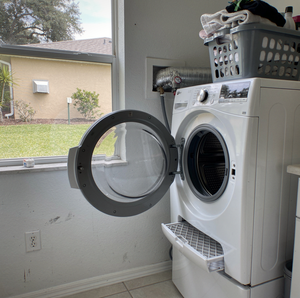
A gas dryer and an electric dryer are built around the same machine. Each has a steel drum turned by a belt, a motor that drives both the drum and a blower wheel, a lint screen in the air path, and an exhaust duct that carries warm, damp air out of the house. Both dry a load the same way: room air is drawn across a heat source, pushed through the tumbling clothes, and sent outdoors with the moisture it picked up. The one system that differs is the heat source. A gas dryer burns fuel in a burner, lit by an igniter and fed through a gas valve, while an electric dryer runs current through a heating element on a 240-volt circuit. With everything else shared, the choice comes down to the hookup already waiting in the laundry room and to how each heat source behaves, wears, and fails.
The two types compare part by part and hookup by hookup.
| Point of comparison | Gas dryer | Electric dryer |
|---|---|---|
| Heat source and its parts | Burner, igniter, flame sensor, and a gas valve with its coils | Heating element in a metal element housing |
| Laundry-room hookup | Gas supply with a shutoff valve, plus a standard 120-volt outlet | Dedicated 240-volt dryer circuit and receptacle |
| Venting | Outdoors only; the exhaust holds combustion products along with moisture and lint | Outdoors; the exhaust holds moisture and lint |
| How heat comes up | The igniter glows first, then the burner lights and gives its full output | The coil heats as soon as current flows through it |
| Heat-source wear parts | Igniter, gas valve coils, flame sensor | Element coil, heater relay on electronic models |
| Shared wear parts | Belt, drum rollers or glides, blower wheel, motor | The same parts |
| Switching to this type | A gas line has to reach the dryer spot | A 240-volt circuit has to reach the dryer spot |
Parts the Two Dryers Share
The drum is a steel cylinder that turns on rollers or glides, driven by a belt wrapped around its outside and around a pulley on the motor shaft. The same motor spins the blower wheel, which pulls air through the drum and pushes it into the exhaust duct. The lint screen sits in that air stream, at the door opening or in the top of the cabinet, and catches fiber before it reaches the blower. The vent runs from the cabinet's rear panel to a hood on an outside wall. The door switch, the timer or control board, and, on auto-dry models, the moisture sensor bars also belong to both types.
Because these parts perform the same function in both machines, they wear out the same way. A belt stretches and frays, a drum roller flattens and squeals, and a blower wheel can loosen on its shaft. Drying time on either type also rests on this shared hardware: how freely air moves through the screen and duct, and how the load tumbles. Lint packed in the vent is a fire hazard, regardless of which heat source sits upstream of it.
How the Gas Heat Train Works and What Wears in It
When the cycle calls for heat, the control sends power to the burner circuit. Current first reaches the igniter, a small ceramic part that glows orange-hot at the mouth of the burner tube. The flame sensor, mounted on the burner tube, is a heat-sensing switch. While it is cold, it keeps the igniter powered; once it senses the igniter's heat, it switches the circuit so the gas valve's coils open the valve fully. Gas flows through a small orifice into the burner tube, mixes with air, meets the glowing igniter, and lights. From that point, the burner transfers heat to the air stream headed for the drum, and the igniter cools while the flame burns.
Three parts in that sequence wear with use. The igniter is brittle and heats at every call for heat; over time, it can weaken until it glows without reaching the ignition temperature, or crack and stop glowing altogether. The gas valve coils are wire windings that open the valve magnetically; a coil can fail open or weaken, so it holds the valve only while it is cool. The flame sensor's contacts can stick in one position, either keeping the igniter glowing with no gas flowing or cutting it off before it heats.
All three sit in the gas train, beside the valve and the burner, so testing and replacing them is a technician's job.
How the Electric Element Works and What Wears in It
An electric dryer's element is a coil of resistance wire strung on ceramic insulators inside a metal housing. Depending on the design, the housing sits behind the drum or in a duct at the back of the cabinet, and incoming air passes over the coil on its way into the drum. When current flows through the coil, the wire heats, drawing on the full 240-volt supply. On models with electronic controls, a board-mounted relay closes to send power to the element when the control calls for heat.
The coil is the part that wears. Every heat cycle expands and contracts the wire, and a spot that has thinned can break open; a broken coil carries no current and makes no heat. A coil can also sag off its insulators and touch the metal housing, which grounds the element. Depending on where it touches, a grounded element can keep heating when it should be off, or trip the breaker. The relay's contacts carry the element's full current each time they close, and contacts that have burned can fail to close or weld shut, keeping the element powered.
The element and the relay both sit on the 240-volt side of the dryer. Work on either one starts with the dryer unplugged or its breaker switched off, and it stays with a technician.
The Laundry Room Hookup Decides First
The laundry room settles the question before any feature list does. A gas dryer needs a gas supply pipe with a shutoff valve at the dryer location, plus a standard 120-volt outlet for the motor, controls, and igniter. An electric dryer requires a dedicated 240-volt circuit with a dryer receptacle.
A gas dryer runs on natural gas or on propane. The burner's orifice is sized for one fuel, so a dryer set up for natural gas and moved into a home on propane needs a conversion kit, fitted by a qualified gas professional, before it runs there.
A burner fed the wrong fuel shows it in the flame. A natural-gas orifice-fed propane overfires, passing more gas than it can burn cleanly and producing soot and carbon monoxide; a propane orifice-fed natural gas underfires, producing a weak flame.
Going from electric to gas means running a gas line to a laundry room that lacks one; going from gas to electric means running a 240-volt circuit from the panel. The gas line is work for a gas-qualified contractor, with the gas utility involved when the house itself needs gas service, and the circuit is work for a licensed electrician. Either one is work the local authority may require a permit for, and the local authority decides.
Behind a gas dryer, a flexible connector joins the dryer's gas inlet to the shutoff valve. A qualified professional handles that connector and valve; the homeowner does not pull, bend, or reconnect them, even to slide the dryer out. An electric dryer is unplugged, or its breaker is switched off before anything behind it is touched. A smell of gas in the house means everyone leaves, and the call to the gas utility is made from outside, with no lights or appliances switched on or off on the way out.
Venting and Why a Gas Dryer's Exhaust Carries More Than Lint
Both types push the same moist, lint-laden air through the same kind of duct to an outdoor hood. A gas dryer's exhaust also carries what the burner produces: water vapor and carbon dioxide from clean burning, and carbon monoxide when combustion is incomplete. A gas dryer is vented outdoors only, never into the laundry room, a garage, an attic, or a crawlspace. A duct joint that has pulled apart behind a gas dryer releases combustion products and lint into the house.
The protection against it consists of a vent path that remains sealed all the way to the outside hood and a carbon monoxide alarm in the home. An electric dryer's exhaust contains no combustion products, but it still contains the same moisture and lint, and it also belongs outdoors.
Carbon monoxide from a gas dryer with a separated or blocked vent has no color or smell and can overcome people indoors. When a CO alarm sounds, everyone gets outside, the gas utility is called, and a technician checks the dryer.
Matching the Dryer to the Household
The existing hookup comes first because it decides what can go in without new supply work. A laundry room with a gas line and no 240-volt circuit is set up for gas; one with a 240-volt circuit and no gas line is set up for electric. When both are present, or when the household is weighing new supply work anyway, the choice moves to how each heat source fits the home.
A gas dryer brings a fuel system and a combustion exhaust into the laundry room, while an electric dryer keeps the room to one supply, the 240-volt circuit, and a vent that carries moisture and lint alone.
Neither type ranks above the other. Both need the same lint and vent care, both run on the same drum, belt, motor, and blower, and both heat sources are serviced part by part rather than as a whole unit. A household that already has one hookup in place and is comfortable with that type's parts and upkeep can stay with it; one weighing new supply work is choosing between a fuel system with a combustion vent and a high-voltage circuit.
Frequently Asked Questions
Does a gas dryer still work during a power outage?
No. The igniter, the gas valve coils, the motor, and the controls all run on household electricity, so a gas dryer stops when the power is off, just as an electric one does.
Why do electric dryer cords have three prongs in some homes and four in others?
The cord matches the receptacle. A four-prong cord carries two hot legs, a neutral, and a separate ground wire, while the older three-prong type combines the neutral and the ground into a single conductor. Some electric dryers ship without a cord, so the cord is chosen to fit the home's outlet, and an electrician handles any changes to that outlet.
Is it normal for a gas dryer's flame to go out partway through a cycle?
Yes, when the thermostat turns it off. A cycling thermostat opens once the exhaust air reaches its set temperature, closing the gas valve; as the air cools, the thermostat closes, the igniter glows, and the burner relights. A flame that drops out while the thermostat is still calling for heat is a fault.
What color should a gas dryer's burner flame be?
Blue and steady. A lazy yellow flame is a sign of incomplete combustion, where the mix of gas and air at the burner is off, while brief orange flecks can come from dust or lint burning off in the flame. On models with an adjustable air shutter at the burner, setting it is a technician's adjustment.
Can an electric dryer plug into a standard 120-volt outlet?
A full-size electric dryer cannot, since its element is built for a 240-volt supply. Some compact electric dryers are built for a 120-volt outlet, with a smaller element sized for that supply.
How can a model number show whether a dryer is gas or electric?
On several brands, one letter in the model number marks the heat source, a G for gas and an E for electric, with the rest of the number matching between the two versions. The model number is printed on a label inside the door opening or on the back panel, depending on the model.
Secure dryer repair for gas and electric models — igniters, gas valve coils, heating elements, belts, blowers and vent cleaning. Freedom Appliance of Tampa Bay serves Tampa Bay and Riverview. Call (813) 302-7672.