
Is It Worth Repairing an Oven? Let the Failed Part Decide
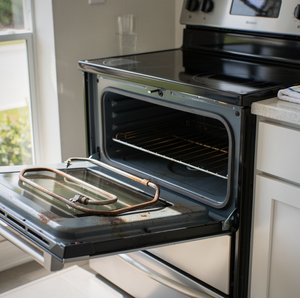
When an oven quits, the range is best seen as several appliances sharing one cabinet: a cooktop, an oven heat source, a set of controls, and a door that closes over a steel cavity. Each of those systems wears on its own schedule, and a fault in one says little about the health of the others. The repair-or-replace question is settled by which system failed and by the condition of the systems that still work, with the age on the data plate as one of several inputs. Here is each failure a range can present, paired with how it leans and the reason for that leaning.
| Failure | Leaning | Reason |
|---|---|---|
| Bake or broil element | Routine repair | A self-contained heater that swaps out without disturbing the cavity or the controls |
| Gas oven igniter | Routine repair, technician only | A wear part beside the bake burner, wired to the gas side of the oven |
| Temperature sensor | Routine repair | A single probe with its own connector, replaced without touching the heaters or the board |
| Control board or touch panel | Depends | Turns on whether the exact part, or a successor that fits, can still be bought |
| Surface element or burner switch | Routine repair | Each cooking position has its own heater and its own switch, so the fault stays local |
| Cracked glass-ceramic cooktop | Depends, leans to replacement | A large, model-specific panel, and it must still be sold for the model |
| Door hinge or gasket | Routine repair | Hardware that fastens to the door and the frame |
| Rusted or chipped cavity | Leans to replacement | The liner is the oven box itself |
| Gas valve | Depends | Replaceable, but every joint it touches has to be leak-tested, and supply varies by model |
Parts That Count as Routine Repairs
A repair counts as routine when the failed part is self-contained, sold for your model, and can restore the system to full function once fitted. The oven's heaters meet that test, including the third element around the fan on true-convection models and a bake element hidden beneath a smooth floor panel on some ovens, which takes more disassembly to reach.
Weak igniters, drifting sensors, and elements that heat slowly each have their own symptoms; for this decision, what matters is that each one is a single part with a single job.
The cooktop follows the same logic. A coil element plugs into a receptacle, and an element that has arced can leave that receptacle blackened with pitted terminals; the fix is the element plus the receptacle. Each position has its own switch behind its knob, so a switch fault on the left front burner leaves the other positions still working.
Door hardware is the third routine group. Hinges carry the weight of the door each time it opens, plus any load from someone leaning on it. A bent hinge lets the door sit out of square, and a door that sits out of square cannot press evenly on its gasket. The gasket itself is a separate part that fastens around the front of the cavity, on some models with clips pressed into holes in the frame.
Failures That Push Toward a New Range
Some damage changes the math because it removes a large part, an integral part of the range, or something no longer available.
A cracked glass-ceramic cooktop: The glass top is a single continuous panel that supports every burner position. A crack, even a hairline one, gives spills a path down to the elements and wiring beneath, where liquid on live parts is a shock hazard. Stop using the cooktop once a crack appears and switch the range off at the breaker. Whether a new top makes sense depends on two facts: the panel has to be sold for your exact model, and the oven and controls below it have to be worth keeping, since the top is a large, model-specific part.
A board that is no longer made: On an electronic range, the control board runs the bake and broil circuits. When that board fails, and no new, successor, or rebuilt board can be found, the oven has no way to heat, whatever the condition of its elements. On models where the cooktop runs on its own knob switches, the burners can keep working while the oven sits dark, which leaves a half usable range.
Cavity damage: The oven liner is steel coated in porcelain enamel fused to the metal. A small chip exposes bare steel, and in a box that sees steam and grease at every bake, bare steel can rust. Rust can spread under the surrounding enamel, and on a gas oven it can eat through the floor around the burner opening. On some ranges the liner is listed as a part, but fitting one means stripping the range down to its frame and its insulation, which amounts to rebuilding the appliance.
Heat-damaged wiring: One scorched connection, such as a melted terminal block where the power cord lands, is a part-level repair. Insulation that has turned brittle and cracked along the wiring harness behind the back panel is a different finding, because it shows that heat has been reaching places it was never meant to reach, and it leans toward replacement.
Gas Ranges: Valves, Igniters and Technician-Only Work
A gas range adds a fuel system to the list. Each surface burner has its own valve behind its knob, and on ovens with a glowing igniter, the oven draws gas through a safety valve that opens only once the igniter is hot. A pressure regulator at the back of the range sets the pressure all of these valves see. A burner that will not light is a diagnosis in its own right; for the repair decision, the question is whether the valve, igniter, or regulator involved is still sold.
The parts themselves are replaceable; what keeps this work with a technician is what happens around them. Replacing a valve or an oven igniter means opening gas connections, and every joint that has been opened has to be leak-tested before the range goes back into service. The flexible connector behind the range also has to come back without a kink or a twist once the range is pushed into place. Connections at the valve, regulator, or supply line remain with the technician.
A gas smell near a range can ignite from any spark, including a light switch or a burner igniter, and burn anyone nearby. People leave the house, the gas utility is called from outside, and a technician handles the range afterward.
A gas valve with a slow leak or a stiff stem is more likely to be repaired while it is still sold, since the rest of the range is unaffected. It leans the other way when that valve is no longer available, leaving the oven or cooktop without a working fuel supply.
How Parts Availability Changes the Decision
Range parts are model-specific, and the data plate's model and serial number identify the exact part. A discontinued part can be replaced with a new part number that fits the same range, and the repair proceeds with that successor. When no successor exists, the choices narrow to a used or rebuilt part, which introduces uncertainty about how long it will last.
Availability can differ within one range. The oven elements may still be sold while the glass top is not, or the touch panel may be discontinued while the relay board behind it is still in stock. On some models, the touch panel, the membrane with the printed keys, is a separate part from the board that switches the heaters. On those models, a dead keypad can be replaced without the board, and a failed board can be replaced without the keypad.
The wait matters too: a part that has to be ordered leaves the range out of service until it arrives, and for a household that cooks every day, that stretch weighs on the decision.
An error code on the display names a circuit that tripped a fault check, and several parts can set the same code: the sensor, its wiring, the relay, or the board. Testing the parts on that circuit settles which one failed.
Judging the Rest of the Range Once One Part Is Known
Once the failed part is known, the other systems decide whether the repair buys a working range or one working system.
Cooktop: Every burner or element heats at low, medium, and high; a glass top is free of chips and cracks, and nothing flickers or smells hot around the knobs.
Oven: Bake and broil each heat, the oven holds the temperature it is set to, and on convection models the fan runs.
Controls: Every key responds on the first press, the display shows complete digits, and the clock keeps time through a bake.
Door and cavity: The door closes square and stays closed, the gasket is soft and continuous, the window glass is intact, and the enamel has no bare or rusted patches.
If one part failed and every other system passes, that range is a repair candidate, whatever its age. If the failed part sits beside a second system that is already showing a fault, such as a cooktop with a dead position or a door that no longer seals, the picture changes. In that case, a repair restores one system while the next is already slipping, and the decision has to weigh both repairs.
What a Diagnostic Visit Checks
A diagnosis starts with safety. An electric range is unplugged or switched off at the breaker before any hands-on check, and on a gas range the gas supply is shut before any fuel-side part is disturbed.
The visit identifies the range by its model and serial number, confirms the symptom, and tests the suspect part on its own, so that a replacement goes to the failed part rather than a nearby part. The other systems are also checked: the cooktop positions, the door, the gasket, the cavity, and the controls. The last step is the parts question: whether the part is sold for that model, whether a successor fits, and how long it will take to arrive.
Frequently Asked Questions
Why does one surface element only heat on high?
A switch whose contacts have welded closed does this: power reaches the element continuously, so no setting below high is possible. The element is fine in that case, and the repair is the switch alone.
Is a cracked oven door window a reason to replace the range?
No. An oven door holds more than one layer of glass, three on some models, and where the panes are sold singly, only the broken one is replaced. The door glass is tempered, and a splash of cold liquid on a hot pane can shatter it, so the oven should stay off until the broken pane is replaced.
What happens if the door stays locked after a self-clean cycle?
The latch is designed to hold until the cavity has cooled, which can take a while after the cycle ends. If it never releases, the fault can sit in the lock motor and its switch, a replaceable assembly, or in the control that commands them. On some models, switching the breaker off and back on resets a control that has locked up after the cycle.
Does anything need to be put back in place when a range is pulled out for repair?
Yes, the anti-tip bracket. It is fastened to the floor or wall and catches a rear leg of the range, so a child standing on the open door cannot tip the range forward. A range slid back into place has to re-engage that bracket, and the check is to confirm the rear leg sits inside it.
Where does a range carry its model and serial number?
On a label or plate that sits in different places by model: on the frame behind the storage drawer on some ranges, on the frame inside the oven door opening on others, and under the cooktop or on the back of the control panel on a few. A phone photo of that label keeps the right number on hand for a parts lookup.
Can a cracked glass cooktop be sealed instead of replaced?
No. Glass-ceramic cannot be patched, glued, or filled in a way that restores it, because the top has to survive repeated heating and cooling right above the elements.
Order oven, stove, and range repair — gas and electric models — from the oven's heat source and controls to the cooktop, door, and gasket. Freedom Appliance of Tampa Bay serves Tampa Bay and Riverview. Call (813) 302-7672.