
Why Is My Ice Maker Not Making Ice? Find the Stalled Step
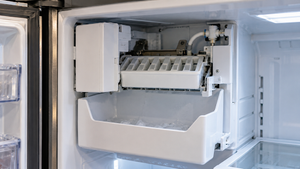
An ice maker is not one device doing one job. It is a short sequence of steps that has to be completed in order every single time: water has to arrive, a valve has to open and measure it, that water has to freeze solid inside a mold, the finished cubes have to release from that mold, and a bin has to accept them and signal the unit to make more. A bin that stays empty does not mean the whole system failed. It means the sequence stopped at one specific step, and everything before that step is probably still working fine.
Working through the cycle in order turns a puzzling empty bin into an actual diagnosis. The sections below follow that order: water reaching the appliance; the inlet valve and the fill; the freeze stage; harvest; and the bin itself, followed by the causes outside the ice maker and what a technician checks that a homeowner cannot.
Quick Answer: An ice maker that has stopped producing cubes has usually stalled at one of five stages in its cycle: water supply, the inlet valve and fill, the freeze stage, harvest, or the bin's shutoff signal. Match the symptom to the stage first.
| Stage | What Should Happen | What You'd Notice If It Stalled Here |
|---|---|---|
| Water supply | A steady line reaches the inlet valve | Bin stays empty, no fill sound at all |
| Inlet valve and fill | Valve opens on signal and measures water into the mold | A faint click with no water, or a fill sound with no cubes later |
| Freeze stage | The mold holds cold enough, long enough, for a full freeze | The cycle seems to run, but nothing ever hardens completely |
| Harvest | The mold heater and ejector arm release the cubes | Motor sound at harvest time, but nothing drops into the bin |
| Bin and shutoff | The unit recognizes a full bin and pauses | Bin fills partway, then production stops |
Water Reaching the Ice Maker at All
Before any of the ice maker's parts can do their job, water has to reach the back of the refrigerator. Most units draw from a dedicated line that branches off the home's cold water supply, controlled by a shutoff valve, either a saddle valve clamped onto a pipe or a quarter-turn ball valve, mounted under a sink or behind the appliance itself. If that valve was ever closed and never reopened, the whole cycle never starts. It is one of the few checks a homeowner can make without tools: confirm the valve's handle sits open.
From the shutoff, a length of supply tubing runs to the refrigerator, often coiled loosely so the appliance can be moved. That tubing can kink if the refrigerator was pushed back against a tight wall, or it can freeze where it runs close to a cold surface inside the unit or through an unheated space. A frozen section stops water from reaching the mold just as completely as a closed valve, just further down the line, and it may not be visible unless the freeze happens somewhere in plain view.
A supply line that fails behind a running refrigerator can leak for hours before anyone notices, since the water spreads under cabinetry and flooring rather than pooling in plain sight. A technician checks the line's condition, not just its water flow.
The Inlet Valve and the Fill
Once water reaches the appliance, a water inlet valve takes over. This is an electrically operated valve, opened by a solenoid, that sits in line and releases a measured amount of water only when the ice maker's controls call for it. Ahead of the solenoid sits a small mesh screen, meant to catch sediment before it reaches the moving parts, and it is one of the more common places for hard water deposits to build a restriction.
From the valve, water travels through a narrow fill tube into the ice mold. Because that tube sits inside the freezer compartment, a small amount of frost forming around its opening is normal. What is not normal is frost thick enough to close the tube's opening entirely, which prevents the fill from starting even though the upstream valve is working correctly. A valve that clicks or hums when the fill should be happening, but no water shows up in the mold, usually points to a fill tube blockage or a valve that is not opening fully rather than a valve that has failed outright.
The Freeze Stage and the Thermostat or Sensor
With water sitting in the mold, the unit has to hold that section of the freezer cold enough, for long enough, to carry it through a complete freeze. A thermostat or an electronic sensor mounted near the mold tracks this and signals the control once the water has gone solid enough to move to harvest. That signal starts the next stage; nothing releases until the sensor confirms the freeze is finished.
If the freezer compartment runs warmer than the model's specifications call for, this stage can take far longer than it should, or fail to complete a full freeze at all, leaving slush in the mold instead of solid cubes. A thermostat or sensor that has drifted or failed reads the temperature incorrectly, regardless of how cold the compartment actually is, producing the same empty-bin result for a different cause. A thermometer and test equipment tell an actual temperature problem apart from a sensor reporting the wrong number.
Harvest: The Ejector Arm and the Mold Heater
Once the freeze stage signals that the tray is finished, harvest begins. On most modern units, a mold heater warms the outer surface of the ice mold just enough to loosen the cubes from the mold walls without melting them, while an ejector arm, driven by its own small motor and gear set, sweeps across the mold and pushes the loosened cubes out into the bin. The two systems work together: the heater releases the grip, and the arm does the moving.
A humming or clicking sound at what should be harvest time, with no cubes dropping, usually means one half of that pair is not doing its job: the heater is not warming the mold enough to free the cubes, or the ejector arm is not completing its sweep across the mold. Either fault can produce the identical symptom from outside the appliance: sound, but nothing landing in the bin.
The Bin, the Shutoff Arm, and the On-Off Control
The last stage is the simplest in concept and still a common stopping point. Mechanical ice makers use a bail arm, sometimes called a shutoff arm, that rides on top of the ice in the bin. When the bin fills enough to lift that arm, the unit reads the bin as full and pauses production. Newer units often replace the arm with an optical or infrared sensor mounted across the bin that detects whether a beam is broken by ice. Either design does the same job: tell the control when to stop.
Both designs can be fooled into stopping even when the bin has room. A bridged or fused clump, several cubes that softened slightly and refroze into one mass, can rest against a bail arm and hold it in the raised, full position, or can sit high enough to interrupt an optical sensor's beam, even though most of the bin below is empty.
Separate from all of this, many ice makers also carry their own on-off control, a paddle, a switch, or a button on the control panel, distinct from the water shutoff valve entirely. This control exists so the ice maker can be paused without touching the water supply, and it is easy to bump off by accident.
Before assuming a stage has failed, check two simple things: that the bail arm hangs freely instead of being pinned up by a clump of ice, and that the ice maker's own on-off control has not been bumped off by accident.
Causes Outside the Ice Maker Itself
Some of the most common reasons an ice maker stops are not problems with the ice maker at all.
Freezer temperature: If the compartment cannot hold a temperature cold enough for the model's specification, every stage downstream suffers, since the freeze stage cannot finish and harvest never gets a properly solid tray to work with. A freezer that runs warm because of a cooling problem elsewhere needs its own separate repair path, worth ruling out with a simple check: does the rest of the freezer, ice cream, frozen vegetables, feel as cold as usual? If not, the ice maker is likely a secondary symptom rather than the primary fault.
Door seal: A door that is not sealing fully has a similar effect. Warm, humid air pulled in past a worn or misaligned gasket raises the compartment's temperature every time it happens, working against the freeze stage, and it can add frost around the fill tube opening that blocks the fill described earlier.
Water filter: Most refrigerators route ice-maker water through a cartridge filter, and a filter that has exceeded the interval specified in the manufacturer's specifications restricts flow enough to slow ice production or stop it outright. A filter installed at an angle, or not seated fully, can block flow even when brand new. Checking how long the current filter has been in service against the manufacturer's interval rules out one more variable before anything else gets inspected.
What a Technician Confirms That a Homeowner Cannot
A homeowner can rule out the shutoff valve, the on-off control, a jammed bin, and a freezer that no longer feels cold, all without opening the appliance. Everything past that point calls for testing, not looking. A technician measures whether the inlet valve opens to full flow and holds a proper seal. A thermostat or optical sensor gets checked against a known reference, confirming whether it reports the freezer's real temperature and bin state or a false one. A mold heater is checked to ensure it reaches the correct resistance, and an ejector motor and gear set are checked to ensure they complete a full sweep rather than spinning without moving the arm.
None of that testing happens from outside the appliance. A visit that traces the cycle stage by stage turns a vague no-ice complaint into a specific finding: which stage stalled, and which part inside it needs replacing.
Frequently Asked Questions
Yes. On units with an optical or infrared sensor instead of a mechanical bail arm, condensation or a thin layer of frost on the sensor's lens can block the beam on its own, so the control reads a false full signal with an empty bin underneath. A technician checks the lens itself, not just the bin.
On many built-in refrigerators, yes: a single water inlet valve with two outlets supplies both the fill tube and the door dispenser. A dispenser running slowly at the same time points to a shared restriction, most often the valve's inlet screen, rather than to two separate problems.
On many French-door and side-by-side models, the ice maker sits inside the freezer door itself rather than in the main freezer compartment, on its own small shelf built into the door panel. That changes where a technician starts, since the door-mounted unit has its own water line connection and seal, separate from the main compartment gasket.
That symptom often points to the ejector arm's gear set rather than the motor itself. The motor can keep running and produce the hum you hear even after its gear set has worn smooth or slipped internally, meaning the motor turns while the arm never sweeps the mold. A technician tells this apart from a heater problem by checking whether the arm physically moves while the sound occurs.
Some models do. Rather than something to install at home, it's a check a technician makes before a cartridge comes out: certain filter housings read an empty slot as a fault and shut off water flow entirely as a safety default, which would stop ice production rather than just slow it.
On some models, yes. A number of ice makers run harvest on a timer or cycle counter that is separate from a full freeze reading, so a freezer just warmer than the manufacturer's specification can trigger harvest before the tray fully freezes, producing small, hollow, or cloudy cubes instead of halting production outright. That pattern points to a temperature or sensor issue, even when the bin is not empty.
Trace your ice maker's cycle with a home visit — pinpointing the exact stage of the stall before any part is replaced. Freedom Appliance of Tampa Bay serves Tampa Bay and Riverview. Call (813) 302-7672.