
Washing Machine Walking Across the Floor? 6 Causes to Check
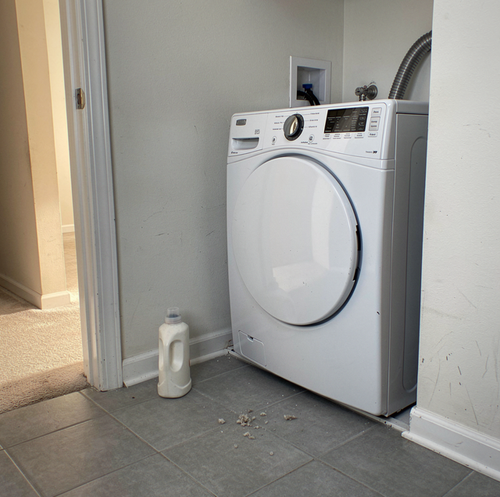
A washer that has traveled six inches out of its alcove did not slide there. It hopped. During the final spin, the drum threw a rotating force big enough to lift one corner of the cabinet clear of the floor for a fraction of every revolution, and each time that corner came down, it landed a hair forward of where it left. A few thousand of those across an eight-minute spin, and the machine is shouldered against the dryer with the drain hose pulled tight.
All of it traces back to one relationship. When wet clothes are not spread evenly around the axis, the effective center of mass shifts off to one side, and an off-center spinning mass exerts a force that scales with the square of the rotational speed. Triple the speed and the force multiplies by nine. An offset the suspension swallows quietly at 400 rpm is nine times as strong at a 1,200 rpm final spin, which is why a washer can run silent for forty minutes and turn violent for the last four.
Some movement is normal. A drum at full spin always hums and shifts the cabinet a little, whether that is six hundred rpm on a top-loader or fourteen hundred on a front-loader, and a machine that buzzes on the tile but stays where it was put is working as designed. Travel across the floor is not. Six causes account for nearly all of it, ordered here by what it costs to guess wrong. You can confirm the first three in five minutes with nothing but your hands. The fourth is a question about the house rather than the machine. The last two mean someone opens the cabinet.
A Single Heavy Item Throws the Largest Imbalance
Stop the machine mid-spin, open the door, and look at where the wash actually sits. If everything has migrated into one dense lump against one side of the drum, or if a single heavy item is riding alone in an otherwise light load, the diagnosis is finished. Pull the load apart, spread it around the full circumference, and restart at the spin.
The worst offender is a rubber-backed bath mat. The backing is closed-cell, so it holds water instead of shedding it the way cotton does, and the mat leaves the wash carrying several times its dry weight, while the towels beside it have drained. It also refuses to drape, staying a stiff slab pinned against the drum wall at the full drum radius. That puts both terms that set the force, the offset mass and its distance from the axis, at their worst.
Machines try to solve this themselves. A front-loader tumbles the load, holds just above 100 rpm to plaster it evenly against the drum, then begins its ramp; if the control still reads a lopsided load, it drops back and retries. After several failed attempts, most machines finish at a reduced speed. A washer that shakes hard and also leaves clothes soaked is telling you it lost that argument with the load.
A Washer Can Rock on a Floor That Is Perfectly Flat
Unplug the machine, then press down firmly on each top corner in turn. If the cabinet drops and clicks under your hand at one corner, that foot is not carrying load. Then grip the top panel and rock the machine front-to-back and side-to-side. Any movement means the setup is wrong, and no amount of load-spreading fixes a machine free to pivot.
This happens on a flat floor because of geometry. A rigid cabinet has four feet, one more than it takes to define a plane, so three of them always touch and the fourth only touches if its height is exactly right. A fraction of a turn on that threaded foot is the difference between carrying load and hovering above the tile. It is also why a bubble level on the top panel is not the test people think it is: a machine can read dead level in both directions and still rock about the diagonal between the two feet holding it up.
Unplug the washer before you reach behind or underneath it, and never try to stop a walking machine with your hands or a knee. A loaded drum weighs enough to pin a foot against the wall.
Back the short foot out a quarter turn at a time until all four take weight with no rock left, then snug the locknut hard against the cabinet base. A loose locknut is why a machine set right months ago is rocking again: vibration walks the foot back down its own thread. Many front-loaders use self-adjusting rear legs instead, and those reseat when you tilt the machine forward a few inches and set it back down.
Shipping Bolts Left in Place Defeat the Suspension Entirely
This applies only to a front-loader that is new or was recently moved, and it is invisible from the front. Unplug the machine, pull it forward far enough to see the back panel, and look for three to five bolt heads in a row across the rear, usually with plastic or rubber spacer collars. If they are there, stop looking for anything else.
Inside a front-loader, the drum and outer tub hang as one heavy assembly on springs, restrained from swinging by dampers. In a delivery truck that assembly would swing hard enough to wreck itself, so the factory bolts it rigidly to the cabinet for transit. With the bolts in place, the springs and dampers never move, and every bit of rotating force passes straight through the frame, into the feet and out to the floor. The machine is not shaking because a part is worn. It is shaking because the parts designed to absorb vibration are clamped solid.
The pattern is distinctive: violent on the very first load, at every spin speed rather than only the fast one, often with a hard metallic banging rather than a rumble. A washer that ran fine for two years and started moving last month is never this. Once the bolts are out, cap the holes with the plugs from the manual bag and keep the bolts, because a machine moved without them refitted can be damaged in transit.
A Flexing Floor Is a Framing Problem, Not a Machine Problem
Two tests separate the floor from the machine. Put a hand flat on the floor two or three feet from the washer during a spin, then repeat standing close to a wall; movement you feel in the floor itself, not just in the cabinet, points to the structure. Then listen through the spin ramp. A machine that shakes hardest at one particular speed on the way up and settles as it goes faster is passing through the floor system's own natural frequency, and it is behaving normally while that happens.
Wood-framed floors deflect under load, and their stiffness declines sharply as the joist span increases. A washer near the middle of a long joist run moves the floor far more than the identical washer set over a bearing wall a few feet away. Second-floor and over-garage laundry rooms show it most, because those spans are the longest in the house.
Set a shallow glass of water on the floor three or four feet from the machine and run a spin. Ripples that appear only at a single point in the speed ramp indicate the floor rather than the load.
The fixes are carpentry, not appliance repair: blocking between the joists, sistering them, or a stiff platform that spreads the load across more of them. Moving the machine over a bearing wall beats all three.
Worn Suspension Turns a Small Imbalance Into a Large One
From here on, you can still confirm the fault yourself, but the repair is a service call. On a front-loader, unplug the machine, grasp the drum at the top, pull it down firmly, and let go. A healthy suspension pulls the drum back to center and settles within about one rebound; if it bounces three or four times, the dampers have lost their grip. On a top-loader, push the basket toward one side and release it. It should swing back and rest centered, not hang to one side or knock the cabinet.
The wear differs by type. Front-load dampers are friction devices: a piston with a lining sliding inside a plastic sleeve, and the lining wears thin until the resistance is largely gone. The tub then swings farther for the same imbalance until it strikes the cabinet. Top-loaders hang the tub on four suspension rods running down from the top corners, each with a spring and a plastic damper cup. Those cups dry out and glaze, and once one rod fails, the other three are the same age, so they go in as a set.
| Front-loader | Top-loader | |
|---|---|---|
| What holds the tub | Springs at the top, friction dampers at the bottom | Four suspension rods at the cabinet corners |
| How it wears | Damper lining wears thin, springs lose their rate | Damper cup dries out and glazes on the rod |
Neither repair is a floor-level job. Front-load dampers usually mean removing the front panel and the door boot clamp, and some designs have to be laid over to reach the mounting pins.
Worn Drum Bearings Announce Themselves by Sound First
Bearings come last because they are the most expensive thing to be wrong about, and because they give themselves away by ear before movement becomes the main complaint. With the machine unplugged, spin the empty drum by hand and listen for a gritty roughness through the rotation, then grip the drum at the top and lift, feeling for play at the rear. During a cycle, bearing noise rises and falls in step with drum speed, peaks at the fastest spin, and continues as the drum coasts down after the motor cuts out.
The failure starts at the shaft seal between the wet side of the outer tub and the bearing behind it. Detergent-laden water and heat break that seal down, water works past, and the grease washes out. Running dry, the races pit and the rolling elements stop tracking true. Once the bearing has real play, the drum shaft orbits within its housing, so the drum no longer turns concentrically about its axis, even with a perfectly spread load. The imbalance is then built into the machine, and redistributing laundry cannot help.
Replacing them means splitting the cabinet, pulling the outer tub, and pressing the old bearing and seal out. On many machines, the outer tub is a sealed two-piece assembly never meant to be opened, so the job becomes a tub-and-bearing replacement. This is the one point on the list where repair or replace turns into a real question, weighed against the machine's age and what has already been replaced on it.
When Movement Is a Symptom of Something Else
A few nearby faults get confused with this one. A machine that hums but will not spin at all, or that ends the cycle with standing water in the drum, is a drive or drainage fault rather than a balance fault. Water on the floor around a shaking machine should be separated from the shaking itself, because leaks have their own short list of sources. A front-loader that smells musty has a gasket and dispenser issue, not a mechanical one.
Frequently Asked Questions
They help a machine that is already level and solid, but do nothing for one that is not. A pad works by isolation, and isolation only starts once the pad is soft enough that the spin frequency sits well above the natural frequency of the machine resting on it. A firm thin pad never reaches that and passes the shaking straight into the floor. The softer the pad, the more freely the cabinet can also move sideways on it, so a machine already rocking on its feet walks farther rather than less.
Not for long, and the risk is usually water rather than the machine. A traveling cabinet drags on the drain hose where it enters the standpipe, and a hose that works its way out will discharge a whole drain cycle onto the floor. The braided fill hoses undergo repeated flexing at their crimped couplings, where a burst can start.
Sometimes it is simply the fastest part of the cycle, but a slow drain gives the same pattern for a different reason. Spin begins while the tub is still emptying, and if the drain pump filter is partly blocked with lint or a coin, a gallon or more can still be sloshing when the ramp starts. Free liquid moves continuously, and no balance routine compensates for it.
It needs it for a different reason. Top-loaders generally top out around 600 to 800 rpm against 1,200 to 1,600 on many front-loaders, so an identical offset throws far less force. But a top-load tub is tall, and its mass sits higher above the feet, so the same tilt produces a bigger overturning moment. Front-loaders are less forgiving of speed, top-loaders less forgiving of tilt.
Coastdown separates them. Cut the power mid-spin and listen while the drum slows under its own weight: a bearing keeps rumbling and drops in pitch with the drum, because nothing but the drum is still turning. A belt or a pump goes silent the moment the motor stops driving.
Yes, by a different route than a single heavy item. An overfilled drum cannot tumble, so nothing redistributes during the balancing phase and the load enters the spin in whatever shape it was washed in. Many front-loaders detect this, abort, and retry repeatedly, adding 10 to 20 minutes before the machine gives up and finishes more slowly. Leaving a hand's width of space at the top of the drum solves it.
Book a washer diagnostic — a technician confirms whether the movement is setup, suspension, or bearings before any part gets replaced. Freedom Appliance of Tampa Bay serves Tampa Bay and Riverview. Call (813) 302-7672.