
Why Is My Microwave Running but Not Heating Food?
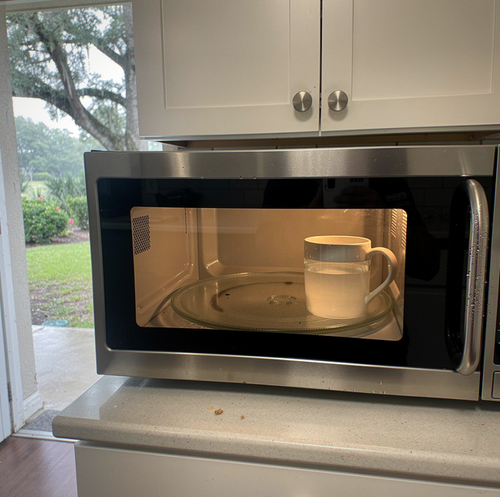
The timer has counted all the way down. Your lamp is on, the turntable is still going around, and the plate you lift out is as cold as it went in. So what was the machine doing for two minutes?
Running and heating are separate jobs on separate circuits, and your microwave can do the first perfectly while the second sits idle. Yours has lost part of the circuit that turns wall current into microwave energy, and everything you can see and hear is still working on ordinary line voltage.
That split is why your machine can look completely alive and still do nothing at all to your dinner. It also puts a hard limit on how much of the answer you can safely reach.
The Difference Between Having Power and Actually Making Heat
A microwave draws ordinary household current at the plug, and most of what that current does inside the cabinet is unremarkable. It runs the clock and the touch panel. It turns the turntable motor. It lights the cavity lamp and, on most units, spins a cooling fan across the back of the tube. All of that sits on the low-voltage side of the machine, downstream of the control board. When your timer counts down, and the plate turns, every one of those parts is reporting for duty and telling you nothing at all about heat.
The heating job runs on a second circuit that switches on only while the oven is cooking, and it steps the incoming voltage up by a very large factor before feeding a vacuum tube that produces the microwaves. Nothing on the low-voltage side runs any differently when the second circuit never comes on, so a machine can look normal for an entire cycle and still hand back a cold plate.
Why Does a Magnetron Need a Circuit of Its Own?
The tube that makes the microwaves is called a magnetron, and it will not run on the 120 volts at the cord. Feeding it requires a short chain of parts working in sequence: a high-voltage transformer that steps the line voltage up, then a capacitor and a diode that, between them, raise and rectify what the transformer produces, and the magnetron at the far end. On some household models, the transformer secondary produces roughly 2,100 volts of alternating current, and the high-voltage diode and capacitor drive that voltage higher still. Together these four parts form the high-voltage circuit.
Those parts are wired and switched together, and a relay on the control board closes only during a cooking cycle to bring them to life. The lamp, the turntable, and the cooling fan never see any of it, so one circuit can go completely dead while the other keeps running its full sequence, and the front panel has no way to report the difference.
So the symptom is honest about itself. A machine that runs the whole cycle and leaves your food cold is telling you that the heating chain, and only the heating chain, has stopped.
Cold Food and Lukewarm Food Point at Two Different Parts
A plate that comes out at room temperature after a full cycle and a plate that comes out barely warm are two different findings, and they change what a technician looks for on the way to your kitchen. Complete cold usually means the high-voltage chain is producing nothing at all, because one component in it has opened or shorted and the whole run is down. Weak heat means the chain is still producing something, and the search moves from what could be broken to what could be sagging.
Service documentation keeps those cases apart, giving a separate entry for an oven that appears to be operating while little heat reaches the load, listing a defective magnetron or relay among the causes. A tube weakened over years of service, a relay closing badly, and a diode that has failed outright all present through the same little window, and the difference is how much heat arrives instead of whether any arrives at all.
Take your own evidence before anyone comes out. Put a mug of tap water in, run it for one minute, and then feel the water. Water that comes out noticeably hot tells you the heating chain is alive, and the remaining question is how strong it is. Water still sitting at tap temperature says nothing in that chain fired at all.
Inside the High-Voltage Circuit, and the Part That Usually Goes First
A standard no-heat procedure begins by measuring the voltage arriving at the high-voltage transformer, then works through the power supply components, then checks the connections at the magnetron, and replaces the magnetron only once everything ahead of it checks out. That order exists because the parts ahead of the tube are quicker to test and fail more often than the tube in your machine. It is a sequence, and skipping ahead is how good tubes get thrown away.
The capacitor and the diode sit in the middle of that chain and carry the whole load every time your oven runs. A shorted diode drops the voltage the magnetron needs and often takes the fuse with it. An open capacitor breaks the voltage-doubling arrangement entirely, so the transformer keeps humming, and the tube gets nothing usable. Both faults produce the same outward picture as a dead magnetron, which is why the order of testing matters more than a guess about the part.
The magnetron itself is a wear part. Its filament runs hot for every minute of its cooking life, and a tube that worked hard for years can lose output well before it stops entirely. A technician reaches it last for a practical reason: pulling a good tube because something feeding it had quietly failed is the commonest way to fix nothing at all.
The door has its own place in this circuit. Interlock switches on the latch assembly gate the high-voltage side, and they are wired so the oven cannot produce microwaves with the door open. A fault there usually leaves the whole unit dark instead of letting it run and stay cold, which is why a microwave that still counts down for you is pointing away from its door and toward the chain behind it.
Every Safe Check on a Microwave Happens With the Cabinet Closed
There is a short list of things worth confirming from outside the machine. A standard no-heat check starts with demonstration mode, which lets every function run while the magnetron stays switched off, then asks whether your door closes properly and whether there is clearance around the unit. One point worth holding on to: as long as the food is warming, the oven does not need service.
A microwave's high-voltage capacitor can still hold a charge even after the cord is disconnected from the wall, so leave the outer cabinet screwed down and hand it to a technician who discharges the capacitor through a resistor before touching it.
Past that point, the evidence sits behind a steel wrapper and is read with meters and a discharge tool, such as a 20,000-ohm, 2-watt resistor. On some models, none of the door switches can be adjusted, so a defective one gets replaced. So the object in front of you stays as it is: a closed cabinet, a row of screws along its back edge, and a door still sealing and still telling the switches that it is shut.
Frequently Asked Questions
Heat that arrives and disappears mid-cycle points at a thermal protector rather than a failed part. On some models, a thermostat on the magnetron opens at 293 degrees Fahrenheit and closes again at 230, so an overheating tube cuts your heat and restores it once things cool. Note how many minutes you got before your plate cooled.
Yes, and it is one reason your microwave can survive a storm and still leave your food cold. The relay that switches the high-voltage transformer is located on your control board, and a defective relay, along with a defective magnetron, is among the causes of an oven that runs with little heat. Your display and fan can both look normal to you.
A magnetron that has stopped puts nothing into the cavity, so an oven that stops heating stops emitting. Microwave ovens are built with two independent interlock systems that stop the production of microwaves the moment the latch is released or your door opens. Any damage to hinges, latches, or seals requires a manufacturer or technician to inspect it before the unit runs again.
Portion size is the one ordinary explanation that involves no broken part. A small amount of food gives the tube almost nothing to work into, and dense or frozen items warm from the outside long before the middle. If a full mug of water heats while your dinner stays cold, your load is your answer, and your machine is heating.
Yes. Don't run a microwave oven empty, because doing so can damage the oven or create a fire risk. An accidental empty run of five minutes or less does no harm, and a longer one may make your unit overheat and shut down until it cools.
Behind your door latch sit a primary switch, a secondary switch, and a monitor switch. That third one acts as the backstop: when the primary fails as you open your door, the monitor switch shorts the line and blows your fuse. Your unit goes dark, so your counting-down microwave has cleared its switches.
Book a microwave repair visit — tell the technician what still ran and what stayed cold, and the failed part is found with the cabinet off and the capacitor discharged. Freedom Appliance of Tampa Bay serves Tampa Bay and Riverview. Call (813) 302-7672.