
White Film on Dishwasher Glasses? The Vinegar Test Decides
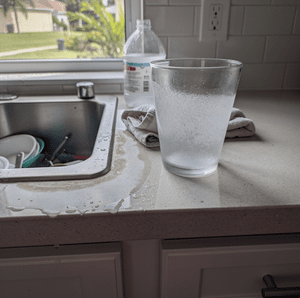
A hazy film across every glass in the cabinet, or a scatter of white spots that catch the light, can come from two different problems that leave nearly the same look on the rack, and treating one for the other wastes a cycle of dishwasher cleaner on a problem it cannot touch. A quick test at the kitchen sink helps you tell them apart before you buy anything or call anyone.
The Vinegar Test That Separates Mineral Film from Etching
Take one clouded glass, dip a corner of a soft cloth in plain white vinegar, and rub a small patch of the film. If the cloudiness lifts and the glass underneath turns clear, the film is a mineral deposit on the surface; a vinegar soak clears the glass, while a descaling cycle on the empty machine removes the buildup inside. If the patch stays hazy no matter how long you rub, or it feels faintly rough under a fingernail, the surface itself has been changed, not coated, and no cleaning step reverses that.
Each look on the glass pairs with its cause and fix:
| What You See | Cause | Fix |
|---|---|---|
| Film wipes away with vinegar; glass turns clear | Mineral deposit from dissolved hardness in the water | A descaling cycle or a vinegar rinse dissolves it |
| Droplet-shaped spots, glasses still wet at the end | Rinse aid out or dispenser not releasing | Refill the reservoir and confirm the dispenser door opens |
| Film stays cloudy after vinegar; feels rough under a fingernail | Etching — permanent surface damage | No fix for the glass; only prevention going forward |
| Spots plus dishes coming out lukewarm, or a visibly weak spray | A machine fault behind the wash, not the water itself | A repair visit finds and replaces the failed part |
Mineral Film from Hard Water
Water carries dissolved calcium and magnesium in amounts that vary from one house to the next and even from one plumbing source to another nearby. Hard water is one possible source of this film, not the only one, and its presence does not by itself tell you anything about your own tap; the vinegar test is what confirms it. As the dishwasher heats water and then evaporates the last film of it off the hot glass, any dissolved minerals that do not evaporate remain as a thin white residue on the surface.
Check the tub walls and door liner, not only the glasses: white scale on the machine's own surfaces shows the minerals are in the water, while film on glassware alone, with a clean tub, points toward the rinse or the detergent dose.
That residue builds up over repeated cycles, which is why the film can look heavier on glasses run through more loads than on ones kept for special occasions and washed by hand between uses. A descaling cycle clears buildup from the tub, the heating element, and the load. That white residue is calcium carbonate, the same mineral scale that builds up on faucets and showerheads fed by the same water.
The Rinse-Aid Dispenser and Water Spots
Without rinse aid, the final rinse beads on the glass instead of sheeting off, and a bead that sits long enough to evaporate in place leaves whatever was dissolved in it as a ring or spot in exactly the footprint it occupied.
If the rinse-aid reservoir has run dry, or the small door covering it has swollen and stopped swinging open during the cycle, the final rinse goes out as plain water. It beads instead of sheeting, and spots turn up glass by glass. Rinse aid left to dry around the dispenser's cap turns gummy, and that residue can hold the dispenser door shut even when the reservoir is still full. Refill the reservoir if it has run dry, and work the dispenser door by hand to confirm it still opens freely before running another load.
Etching: The Film That Does Not Come Off
Etching is a pattern of microscopic pits worn into the glass itself, not a coating sitting on top of it, so no amount of vinegar, rinsing, or polishing brings it back. Two conditions drive it, and they push in the same direction rather than opposing each other: water with very little dissolved minerals, and more detergent than the load needs. Softened or naturally soft water leaves detergent's alkaline compounds with nothing to bind to, so instead of reacting with minerals suspended in the water, those compounds act directly on the glass surface during repeated hot cycles. Those compounds are added to cut grease and tie up hardness minerals, and at full dose they act on the wash, whether or not the water gives them minerals to spend themselves on first.
Using a full detergent dose meant for hard water in a soft-water house adds more of that reactive compound to a wash that soft water was already leaving unspent. Cutting back the detergent amount, switching to a formula meant for soft water where one is available, and running a cooler cycle where the dishwasher offers that option all slow new etching going forward. None of that restores a glass that has already been etched; the surface change is permanent, and the only remedy is replacing the piece.
When a Machine Fault Causes the Film
A machine that cannot fully heat, fill, or spray hot water can produce a similar cloudy appearance for reasons unrelated to water hardness or detergent. Water that never reaches the temperature detergent needs to fully dissolve, whether from a fault or a default eco setting holding the wash below that temperature, can leave a chalky film of undissolved powder across an entire load, not just the glasses. A spray arm with mineral buildup narrowing its own holes produces an uneven spray, so dishes in the strong part of that pattern come out clear, while others in the weak zone come out spotted, load after load. An inlet valve that lets in less water than a cycle expects concentrates the detergent in that fill, leaving less water to carry residue to the drain.
Shut off the breaker or unplug the unit before reaching near the spray arm, filter, or wash pump; the heating element and inlet valve carry live current, and any wiring or part replacement is work for a trained technician alone.
What a Repair Visit Checks
A technician working a film-and-spots call starts with the same vinegar test and a look at the rinse-aid dispenser, ruling out water and detergent causes before opening the machine. From there, the check moves to what only a machine fault explains: the water temperature the unit reaches partway through a cycle, the volume the inlet valve delivers against what the cycle calls for, and every jet in each spray arm checked for a blockage a home descaling cycle could not clear. Finding a heating element that has failed open, a valve narrowed by sediment, or arms scaled past what vinegar reaches shows which fault is behind the film and rules out water-hardness treatments for a problem the water never caused. A follow-up cycle, run before the visit ends, confirms the repaired part now heats, fills, and sprays the way the cycle calls for.
Frequently Asked Questions
Can a dishwasher cleaner tablet fix etched glass?
No. A cleaner tablet dissolves mineral scale sitting on a surface, and etching is damage in the glass itself. Etching announces itself early as a faint rainbow sheen near the rim before it clouds over, so glasses showing that sheen are the ones to pull from the machine first.
Does plastic dinnerware show the same film as glass?
Yes, plastic can pick up the same dull mineral coating, but because plastic scratches more easily than glass, scrubbing at the film with anything abrasive wears the plastic's own finish along with the deposit. A soft cloth and a full soak in a vinegar solution clear it without dulling the surface underneath.
Can too little detergent leave a film?
It can. An underdosed wash in hard water leaves the minerals with nothing to bind to, so they settle onto the load as a gritty film that vinegar lifts. That film is the opposite of etching, which comes from too much detergent in soft water, so the vinegar test also tells you which way to adjust the dose.
Does the film show up on plates and flatware too, or only on glass?
Mineral film settles on everything the rinse water dries on, so plates and flatware carry it too, though it is easiest to see on clear glass. Etching attacks the glass itself and leaves stainless flatware untouched, so a dull film on every surface points to minerals, while haze on the glasses, with clean plates beside them, points to etching.
Do crystal and everyday glassware etch at the same rate?
No. Lead crystal's composition withstands alkaline attack from etching less well than the soda-lime glass of everyday drinkware, so the same soft-water-and-detergent wash clouds crystal sooner and more visibly. Hand-washing stemware while running everyday glasses through the machine avoids the difference entirely rather than relying on a gentler cycle setting.
Does running the dishwasher less often slow the film down?
Per load, no. Mineral residue builds up as water evaporates off the glass in each cycle, not over the days between cycles, so fewer cycles mean less total film but the same film per wash until the water or dispenser problem is fixed.
Arrange a dishwasher repair visit — the film is tested at the rack, the rinse-aid dispenser is checked, and any heating, spray-arm, or inlet-valve fault behind the spotting is found and repaired. Freedom Appliance of Tampa Bay serves Tampa Bay and Riverview. Call (813) 302-7672.