
Refrigerator Water Dispenser Slowed to a Trickle? Four Suspects
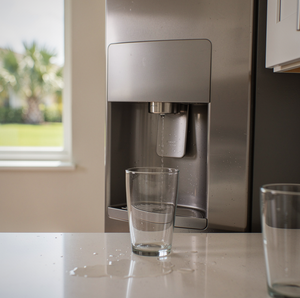
A refrigerator water dispenser that has slowed to a trickle instead of stopping outright is showing a specific kind of symptom: water is still getting through, just not at the rate it should. That distinction matters for diagnosis, because a trickle can trace to any point along the line from the filter to the valve, so it pays to work through the suspects in the order a technician would rather than guessing at just one.
Quick Answer: A slow refrigerator dispenser usually traces back to one of four causes: an overdue filter, low supply pressure, a partially frozen line, or a restricted inlet valve. Rule each one out in that order.
Start With the Filter Cartridge
Every fridge with a water dispenser forces the water through a cartridge packed with activated carbon, designed to trap sediment and reduce chlorine taste before the water ever reaches the tower. That carbon medium doesn't fail all at once. As trapped particulate builds up within its pore structure over months of use, the paths water can take through it narrow, and the flow rate drops in proportion to how clogged the cartridge becomes. That gradual narrowing is exactly why an overdue filter produces a trickle rather than a sudden stop. It's the most common suspect precisely because it's the one part designed to restrict flow a little more every week it stays in service.
A filter has a replacement interval for a reason, commonly around six months of typical use, though heavier household use shortens that window. The tell that separates a filter problem from everything else on this list: swap in a fresh cartridge, seated fully until it clicks or locks into the housing, and watch whether flow returns to normal. If it does, the filter was the restriction. If the trickle barely changes, move to the next suspect.
One wrinkle: a trickle that starts right after a filter swap has two likely sources. Seating a new cartridge traps a pocket of air in the line ahead of it, and that air sputters out through the dispenser as a weak, uneven stream for the first few glasses. Running the dispenser continuously for several minutes to purge that air clears it on its own. If the trickle persists past that point, check that the cartridge is locked fully home before suspecting anything else.
Supply Line Pressure and the Shutoff Valve
The fridge draws its water from a branch off the home's cold supply through its own shutoff valve. Because the dispenser sits at the end of a long, narrow run of tubing that also passes through a valve and a filter, any drop in household pressure that reaches the fridge at all shows up there, further reduced by that added length and those added restrictions along the way.
Household pressure: Check a nearby faucet while the dispenser is running. If that faucet also runs weaker than it should, the pressure problem lives on the house side of the wall, not inside the appliance, and no part inside the fridge will fix it.
The shutoff valve itself: A valve nudged partly closed during cleaning, repair, or a fridge move restricts flow without stopping it outright, which reads exactly like a clogged filter on the dispenser's side. Make sure that valve's handle is turned fully open before ruling out the supply side.
A Partly Frozen Section of the Line
Supply tubing has to route from the back of the refrigerator, through or near the freezer compartment in many models, to reach the dispenser tower in the door. A section that freezes solid stops the dispenser outright: no trickle, nothing at all. A section that's only partly iced is a different story, since it narrows the passage instead of sealing it, and narrowed-but-open is what a trickle looks like from the front of the fridge.
The tell here is time, not tools. After moving the food to a cooler, unplug the refrigerator and let the freezer compartment warm for several hours, then plug it back in and test the dispenser again. If flow comes back close to normal after that, ice was narrowing the line, most likely along the stretch that passes the freezer compartment. A filter or a valve problem doesn't resolve itself just because you waited. If the trickle is unchanged after the compartment has fully warmed, cross ice off the list. Before pulling the plug at all, it's worth checking the freezer's own temperature setting against the manufacturer's recommended range: a compartment running colder than that range can freeze a wider section of the tubing than normal, so a control set too low is a checkable cause on its own, separate from any fault in the line.
The Inlet Valve's Screen and Solenoid
If the filter, the pressure, and a frozen line have all been ruled out, what's left is the water inlet valve itself: the same electrically operated valve that, on many models, also splits toward the ice maker's fill tube, so a slow dispenser and slow ice production showing up together often trace to that shared valve rather than two separate faults.
A small mesh screen sits just ahead of the valve's solenoid, there to keep grit and debris from reaching the valve's internal parts. Where the water reaching the fridge is hard, scale can build up inside the valve, leaving it partly clogged, as it does in any fixture the water flows through. Where the supply runs soft, that buildup tends to remain minor. The valve's diaphragm can also degrade to the point where it opens only partway rather than fully, so the valve still clicks and passes some water on the correct signal, just less of it. Both faults look the same from outside the appliance, and telling them apart means measuring the actual flow at the valve rather than listening for the click that indicates it opened.
What a Technician Checks That You Can't
A homeowner can rule out three of these four suspects without opening the appliance: a filter swap, a check of a nearby faucet and the shutoff valve, and a few hours unplugged to clear a partial freeze. The inlet valve is where the checklist runs out. Confirming it takes a flow measurement against the valve's rated output, not a guess based on sound.
Live electrical connections are located alongside the water lines behind the dispenser tower and rear panel, and removing either without power disconnected poses a risk of electric shock. Leave panel work to a technician; the filter, faucet, and shutoff valve are safe for you to check.
That visit also settles a question a homeowner can't answer from outside: whether the valve's screen is the restriction, or the diaphragm inside it has worn past the point of opening fully. Either one gets replaced as a unit, and a technician confirms which before any part comes off the fridge.
Frequently Asked Questions
Is there a minimum water pressure the inlet valve needs to work correctly?
Yes. The installation manual for most models lists a minimum supply pressure for the inlet valve, commonly about 20 psi on models without a filter and about 40 psi on models with one. Pressure below that minimum lets the valve open on signal but only pass a trickle rather than a full stream, even with every part inside the fridge working correctly.
Does the filter reset itself once a new cartridge is installed?
Often not automatically. Many refrigerators track filter life with their own control board rather than the cartridge itself, so a change-filter indicator light can stay lit even after a fresh cartridge is seated correctly, until a reset button or a specific press-and-hold sequence on the control panel is triggered. Check the owner's manual for the model's reset sequence rather than assuming the light will clear on its own.
Could a whole-house filter or water softener cause this instead of the fridge's own filter?
A whole-house sediment filter can. A cartridge that has loaded up with particulate ahead of every fixture in the home, including the branch line feeding the refrigerator, restricts flow to the dispenser the same way an overdue in-fridge filter does, just one step further upstream and invisible if you only ever check the cartridge inside the appliance. A water softener's resin bed, when it reaches the end of its service life, stops softening the water; on its own, it does not restrict flow the way a loaded sediment cartridge or a stuck valve can.
Does the type of shutoff valve feeding the fridge matter?
It can. A self-piercing saddle valve taps the supply pipe through a small punched hole, and that hole can scale over with use or may never have been fully opened during installation. This valve type is best avoided for that reason, in favor of a standard quarter-turn ball valve on its own fitting.
Can mineral scale build up inside the dispenser's own tubing, separate from the valve's screen?
It can. Scale doesn't only collect at a single restriction point like a screen or a filter cartridge: it can deposit gradually along the inner wall of the tubing itself, over the entire length of a run, narrowing the diameter a little at a time rather than blocking one specific spot. Clearing that kind of distributed buildup usually means replacing the affected section of tubing, since it isn't concentrated at any one part.
Can a brand-new filter still cause a trickle if it wasn't installed correctly?
Yes. Most filter heads have an internal shutoff that opens only when the cartridge turns or clicks into the fully home position. A cartridge stopped short of that point leaves the shutoff partly closed, so a brand-new filter can pass only a trickle.
Have the dispenser's water flow measured at the filter and the inlet valve — that reading is what separates a clogged screen from a worn valve. Freedom Appliance of Tampa Bay serves Tampa Bay and Riverview. Call (813) 302-7672.