
Oven Cooks Unevenly or Won't Heat? 7 Real Causes
QUICK ANSWER: An oven that bakes unevenly or never reaches temperature usually has a failing heating element or gas igniter, a temperature sensor reading wrong, calibration that has drifted, or blocked airflow from overcrowding or foil on the racks. A few checks with an oven thermometer sort the DIY fixes from the parts that need a technician.
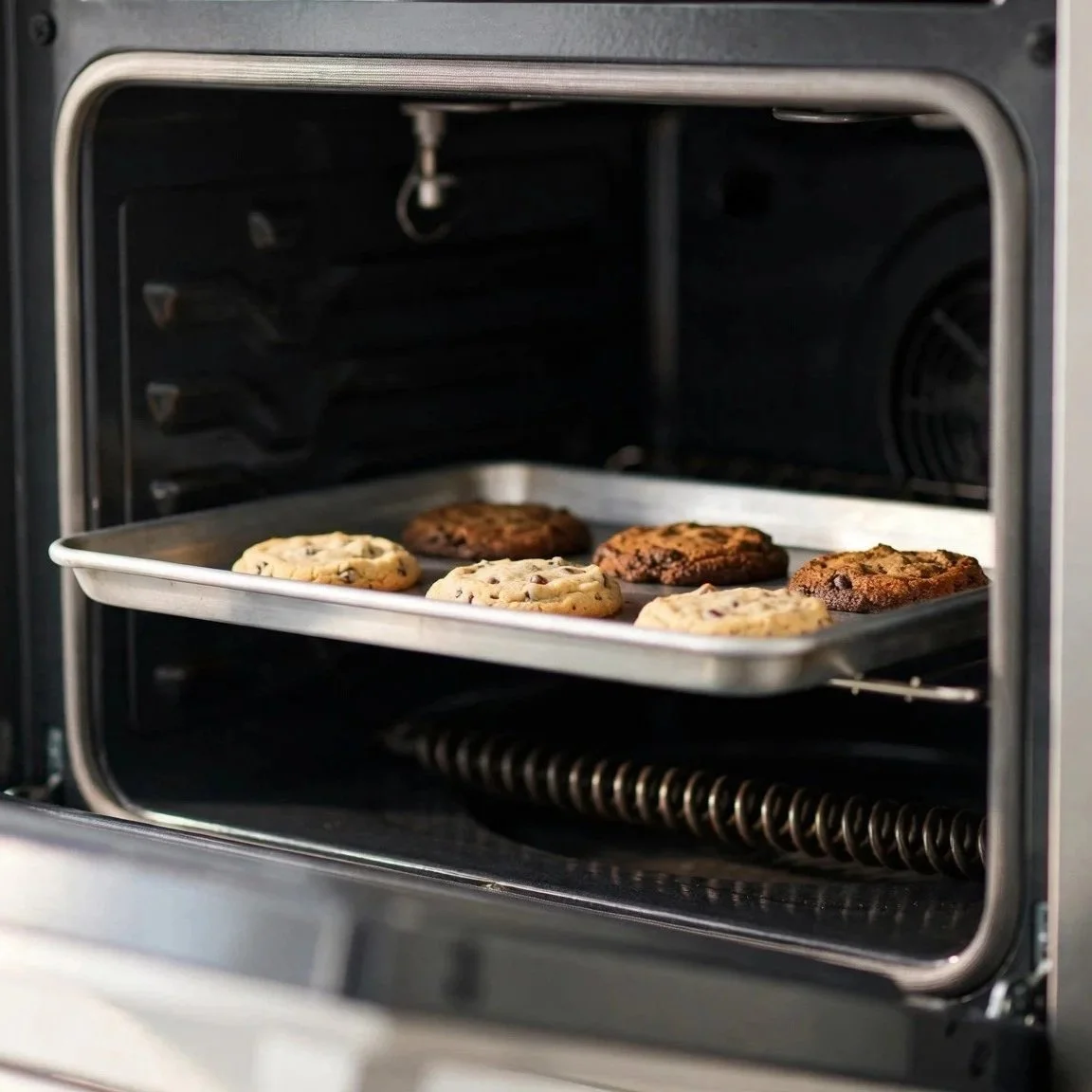
You slide in a tray of cookies, set the timer, and pull out a batch where the back row is scorched, and the front row is barely set. Or the preheat beep never comes, and a roast that should take an hour is still pink at ninety minutes. Uneven baking and an oven that won't reach temperature are two of the most common appliance complaints, and both trace back to the same short list of parts.
How An Oven Actually Holds A Temperature
Your oven is not a simple on-off box. It is a feedback loop. One or two heating sources warm the cavity, a sensor measures the air, and the control board switches the heat on and off many times through the bake to hold the number you dialed in.
On an electric oven, the heat comes from two coiled elements: a bake element on the floor of the cavity and a broil element on the ceiling. On a gas oven, a burner under the floor does the work, lit by an igniter that has to glow hot enough to open the gas safety valve. Either way, a temperature sensor, a thin metal probe usually mounted at the upper rear of the cavity, reports the air temperature back to the control board. When the air drops below the setpoint, the board calls for heat. When it climbs past, the board shuts the heat off.
That cycling is why a working oven feels like it surges warmer and cooler if you watch an oven thermometer closely. A normal swing is a few degrees above and below the target. When one part of that loop weakens, the swing widens, one zone of the cavity runs hotter than another, or the oven never catches up to the setpoint at all.
Why One Side Cooks Faster Than The Other
Uneven browning is almost always an airflow or a heat-distribution problem rather than a dead part.
Overcrowding and foil block the heat path: Heat has to move around the food. Pack three loaded sheet pans in at once, or lay foil across a rack to catch drips, and you dam up the natural convection inside the cavity. The zone nearest the element roasts while the shaded zone stalls. Lining the oven floor or a rack with foil also traps heat against the bottom element and can throw off the sensor's read of the true air temperature.
The convection fan is not running: Many ovens have a fan at the back that pushes hot air around for even cooking. When that fan motor fails, or its blade seizes, the oven falls back to still-air baking, and hot spots return. You can hear a healthy convection fan spin up shortly after the oven starts. Silence during a convection setting points to the motor.
Rack position puts food in a hot zone: The rack nearest an active element browns fastest. Baking on the bottom rack close to the bake element chars cookie bottoms; the top rack close to the broil element darkens tops. The middle rack sits in the most balanced air, which is why most recipes assume it.
Why The Oven Never Reaches Temperature
When the whole cavity runs cold, or the preheat drags on forever, the fault is usually in the heat source or the sensor telling the board what is happening.
A failed or partially burned electric element: A bake element that has burned through stops heating entirely, and the oven leans on the broil element alone, so the top cooks and the bottom stays raw. A partially failed element may still glow in spots but not reach full output, which shows up as long preheats and weak baking. Look for a visible break, a blister, or a bright spot on the coil. Treat any element as live: a glowing broken element can shock or burn, so cut power first.
A weak gas igniter: On a gas oven, the igniter has to draw enough current as it heats to trip the safety valve open. As igniters age, they still glow but weaken, and eventually they glow without ever opening the valve, so the burner never lights or lights slowly. A gas oven that takes several minutes to catch, or clicks and glows but produces no flame, usually needs a new igniter. Gas work carries a leak and carbon-monoxide risk, so this is a technician job, not a DIY swap.
A bad temperature sensor: The sensor, a thermistor, changes its electrical resistance as the cavity heats. If it drifts out of range, it feeds the board a wrong number. A sensor reading high tricks the board into thinking the oven is hotter than it is, so the board cuts heat early and the food underbakes. A sensor reading low drives the oven hotter than the dial. A sensor touching the cavity wall instead of hanging in open air will also misread.
Calibration has drifted: Even with healthy parts, an oven can settle into running hot or cold by fifteen to thirty degrees over years of use. The parts all work; the reference point has slipped. This is the single most common reason a cake that always worked suddenly comes out dry or sunken after nothing was replaced.
A Useful Way To Picture The Sensor Problem
A drifted temperature sensor behaves like a bathroom scale that reads five pounds light. Nothing about your actual weight changed, but every decision you make off that number is off by the same amount. The oven is obediently holding the temperature it is told it has reached; the trouble is the reading it trusts is wrong, so the real cavity temperature lands somewhere you did not ask for.
What You Can Check Yourself
Several of these you can rule in or out at home before calling anyone.
TIP: Hang a standalone oven thermometer on the middle rack, set the oven to 350, and let it cycle for at least twenty minutes before reading it. A steadily wrong number points to calibration or the sensor, while a temperature that never climbs or swings wildly points to the heat source.
Recalibrate per the manual: Most digital ovens have an offset adjustment in the settings menu that lets you nudge the oven up or down by a set number of degrees to match your thermometer. The exact button sequence is in the owner's manual. This fixes ordinary calibration drift without any parts.
Stop lining racks with foil and preheat fully: Pull any foil off the racks and floor, spread pans out with room between them, and always wait for the full preheat cycle before loading. An oven that beeps "ready" is often still climbing on the cavity walls even after the air hits temperature, so a few extra minutes helps.
Use the right rack: Move baking to the middle rack for the most even air, and reserve the top rack for broiling and the bottom for pizza or bread crusts you want browned underneath.
What Needs A Technician
Some repairs go past the DIY line, both for safety and because they need the right part and testing.
A technician will meter a suspect element or igniter for continuity and current draw, confirm a sensor's resistance against spec at a known temperature, and check the control board when the heat sources and sensor all test good but the oven still misbehaves. A worn door gasket, which lets measured heat leak out and forces long preheats, is also worth having checked when the seal looks flattened or torn.
WARNING: Cut power at the breaker before touching an element, since a glowing broken element can shock or burn and a self-clean cycle drives the cavity hot enough to cause serious burns. Any gas igniter or gas-valve work carries a leak and carbon-monoxide risk, and if you ever smell gas, leave the home and call the gas utility before anything else.
Frequently Asked Questions
Most electric ovens reach 350 in roughly ten to fifteen minutes, and gas ovens often take a touch faster because the burner puts out heat quickly. If yours consistently needs twenty-five minutes or more, suspect a weakening element or igniter before you blame the recipe, and confirm the number with a separate thermometer rather than trusting the panel's ready beep.
Yes. Heavy baked-on spills near the bottom element can insulate it and slow heat transfer in that spot, and splatter shielding the sensor probe can skew its reading. Wiping the cavity and keeping the sensor probe clean helps, but avoid running a self-clean cycle to fix a heat problem, since the extreme heat of self-clean can stress the control board and blow a thermal fuse.
Bake and broil use two separate elements or, on gas, two separate burner functions. If one mode heats and the other does not, the working mode proves the control board and sensor are fine, and the dead mode points squarely at that single element or burner. That split is a useful clue a technician uses to isolate the failed part quickly.
An electric bake or broil element is one of the more approachable swaps because it usually mounts with two visible screws and two wire terminals inside the cavity. The non-negotiable step is shutting off the breaker, not just the oven, before you touch it, since the terminals stay live otherwise. If the wiring is scorched or the terminals are corroded, stop and let a technician handle the connection.
More than most people expect. Each door opening can drop the cavity by twenty-five to fifty degrees, and a healthy oven then has to cycle the element back on to recover, which lengthens bake time and can flatten cakes and souffles. A worn or flattened door gasket does the same thing continuously, bleeding heat the whole bake, which is why a bad seal often masquerades as a weak element.
A gradual shift usually means calibration drift or an aging sensor, both of which creep in slowly. A sudden change more often signals a partially failed element that has lost part of its output, or a sensor that has finally drifted out of range. The oven thermometer test tells you which: a steady wrong number points at calibration or the sensor, while a temperature that never climbs or swings wildly points at the heat source.
Skip the guesswork on a misbehaving oven — get an accurate diagnosis and a clean, dependable repair. Freedom Appliance of Tampa Bay serves Tampa Bay and Riverview. Call (813) 302-7672.